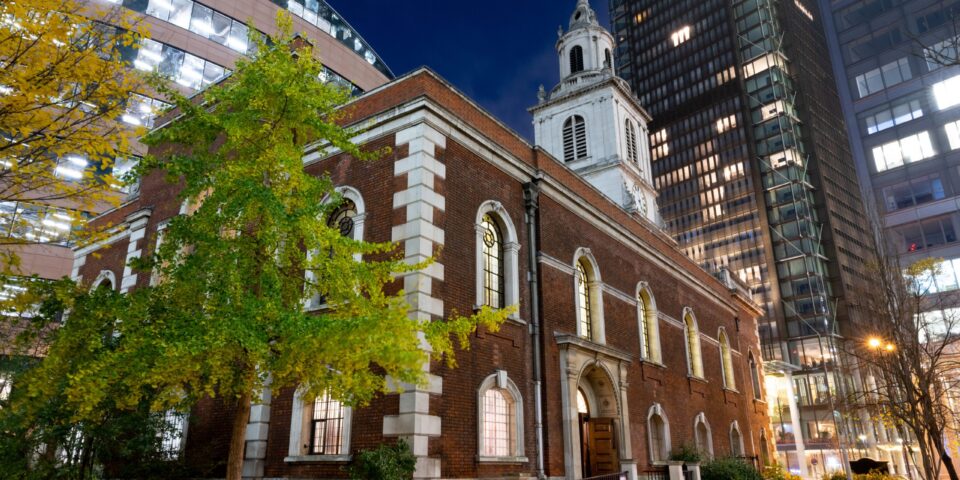
Today we give thanks for St. Botolph, patron of this parish in the heart of the city. In a world that so often teaches people to build walls, Botolph built a gateway.
Unlike some of the other saints who slayed dragons and fought with demons, Botolph is remembered not for power or display, but for kindness, compassion, and welcome. Rather than making his community into a fortress, he made it a place of refuge for strangers and weary travellers.
The early chroniclers used a striking phrase for him: they called him “a man of unparalleled sweetness and life.” In an age marked by conflict and suspicion of outsiders, those who came to Botolph’s door—travellers, strangers, the poor, the sick—were received with dignity, shelter, and protection. His life became a witness to quiet, steadfast hospitality.
And so, his witness asks us, as a Church, a searching question today: who are we welcoming, and what sort of sanctuary are we becoming?
An age of anxiety and anger
If we are honest, our own times is not so different in spirit from Botolph’s. We too live with fear, uncertainty, and deep division. Ours is an age of anxiety and anger. And much of that anger is born of anxiety—of the lie that there will not be enough, that our future is slipping away, that we can be made safe only by shutting others out. In the language of our scriptures, this is what happens when shalom is lost—when the peace, wholeness, and right ordering God desires for creation gives way to restlessness and fear.
One sign of that loss is our retreat into tribes and echo chambers. When we hear only the voices that echo our fears, we do not become wiser; we become smaller. But the Gospel will not let us hide in the false safety of the tribe. It summons us into the wider, braver life of the Kingdom, where every neighbour bears the image of God and no one is disposable.
From anxiety to sanctuary
This is why today’s Gospel matters so deeply. Jesus speaks directly to the anxieties that drive human behaviour: What shall we eat? What shall we drink? What shall we wear? These are questions of survival. Yet Jesus sees how quickly fear about tomorrow can govern the heart and make us live as if scarcity were the deepest truth about the world.
And when fear rules a society, imagination contracts. We begin to say of housing, healthcare, community, even compassion: there is not enough. But scarcity soon becomes more than an economic argument; it becomes a moral excuse. And once we accept that excuse, the gates begin to close. The stranger is no longer seen as neighbour, but as threat.
That is the spiritual danger Jesus exposes. When our own survival becomes the centre of everything, we begin to scapegoat the vulnerable. Those who have already lost so much are made to carry the weight of other people’s fear. And whenever that happens, society is not becoming stronger; it is becoming crueller.
A test for the Church
That is why the plight of refugees and asylum seekers becomes, for the Church, a searching test. The Gospel asks whether we are living out of the panic of survival or the peace of the Kingdom, and whether the Church will echo the fears of the age or speak with the courage of Christ.
For Christians, welcoming the stranger is not an optional extra, nor a passing political mood. It is woven into the Gospel itself. Our Lord Jesus Christ was once carried into Egypt as a child refugee, fleeing the violence of Herod. To look into the face of the displaced is, in a profound sense, to encounter the vulnerable Christ.
Botolph understood this. He did not measure welcome only by what seemed prudent or safe. He trusted that God’s providence was deeper than fear. And because he did not surrender to anxiety about tomorrow, he was free to serve those who stood before him today.
If this church is to be a sanctuary of welcome, then it must be a place where the harsh labels of public discourse are broken open and refused. When people are reduced to categories, the Church must insist on their God-given dignity. We are called to say, clearly and without apology: this person is not a problem to be managed, but a child of God to be received.
Do not worry about tomorrow
At the heart of the Sermon on the Mount, Jesus names one of the deepest habits of the human heart: worry about tomorrow. He does not dismiss our needs; he calls us to trust the heavenly Father who knows them already.
“Therefore, I tell you, do not worry about your life, what you will eat or drink; or about your body, what you will wear … Can any one of you by worrying add a single hour to your life?”
Instead of being consumed by fear, Jesus calls us to seek first the Kingdom of God. That is not an escape from the world’s pain. It is the only way to live truthfully within it.
For when self-preservation becomes our highest goal, we lose our bearings. History shows what follows when societies under strain blame the vulnerable for their fears: truth is distorted, compassion is weakened, and cruelty begins to sound reasonable. The Gospel names that temptation for what it is and calls us to another way.
So during this Refugee Week, as public attention turns again to those fleeing persecution and war, we are gathered here under the patronage of St. Botolph. His witness is not merely historical; it is prophetic.
Botolph embodied the teaching of Jesus. He trusted God, and so he did not let fear harden his heart. His life reminds us that when we know ourselves to belong to God, we become freer to open our doors to others.
Radical Hospitality
If that is true, then our response cannot remain at the level of ideas or sentiment. It must become practice. We are called to a hospitality that is courageous, concrete, and costly. Not because it is fashionable, but because the Gospel commands us to do so.
And that means resisting not only fear, but also apathy. Christian tradition sometimes names this as acedia: a spiritual weariness that leaves us numb to the things of God. When the world is noisy and exhausting, it is tempting to turn away. But Christian faith does not permit us the luxury of indifference. Silence in the face of cruelty is never neutrality; it is surrender.
To stay spiritually awake is not to pretend that everything is simple. It is to remain attentive, prayerful, and compassionate, be it in public or private life. We stay engaged not because we possess every answer, but because we follow the Crucified One who is the Way.
So may God give us grace to dismantle the fortresses of our own minds, to reject the idols of fear and the numbness of apathy, and to become, like St. Botolph, build a place of sanctuary and welcome to all those, especially those who are seeking life and security.
May Christ save us from the fearfulness that calls itself prudence, and from the hardness of heart that disguises itself as common sense. And may we hear again the liberating command of Christ: seek first the Kingdom of God, and do not be ruled by fear. Amen.
Sermon preached at St Botolph-without-Bishopsgate on the Feast of St Botolph, 2026
