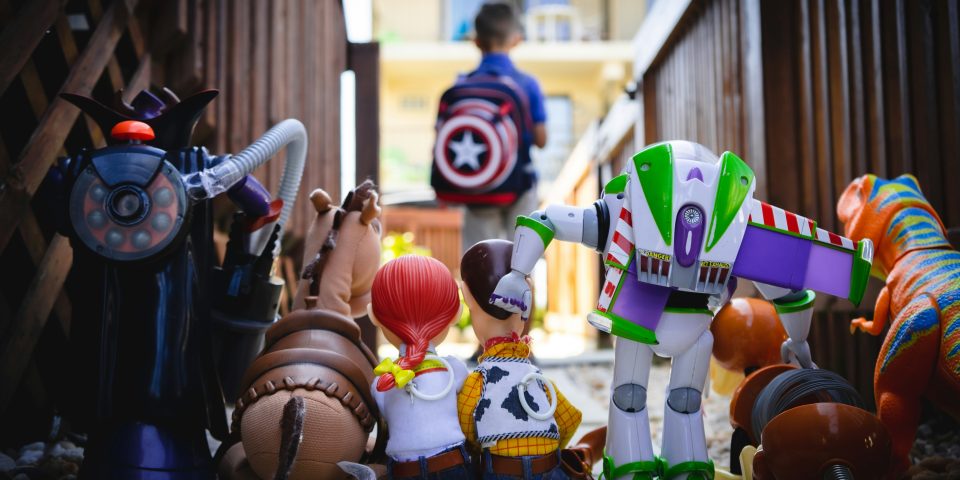
Back in 1995 when we were introduced to Woody and Buzz in Toy Story, some of us were the same age as the children we now work with. Watching the latest instalment of the franchise felt a little surreal, as it’s been years of us growing up alongside these characters and learning so much from them.
Over the past few years, we have seen a lot of talk about the impact of social media, the internet and technology on children and young people’s development. The COVID-19 pandemic seems to have accelerated the use of social media1, fundamentally changing how we interact with technology. It’s an odd time to be alive as we look back and observe how, for many of us, our childhoods were largely unaffected by the internet. We could log off and get on with our day. There were multiple ways to interact with people and engage in play and educational resources away from the internet. Social media didn’t exist yet! We had the luxury of being bored and experiencing a truly analogue world, and Toy Story 5 explores this distinction. The film is an ode to the beauty of childhood and play, and how we adjust to technology.
Unseen worlds
The tension of what it means to be a child in the modern world is the main storyline of Toy Story 5. As we journey with the Toys and Lily Pad, a tablet device, the film brilliantly captures how equally connected and disconnected we are in the present day. Children are balancing offline and online worlds that are just as scary, daunting and beautiful as one another. We are the most connected we have ever been in history, with the opportunity to see so much at the click of a button. We often forget that this is also the experience of children and young people.
This isn’t entirely a bad thing. It can be good. There is a duality to existing in a tech-focused world, and Lily Pad, the proposed antagonist, is a wonderful example of how technology can be addictive when children are exposed to it unrestricted. Their attention can be dulled and their capacity to express themselves diminished, all through a screen that adults don’t really have as much access to, or control over, as we’d like to think. It’s important to keep children protected, and shows like ‘Adolescence’ and documentaries like Louis Theroux’s ‘Manosphere’ give examples and reasons for this.
Growing up too quickly
Repeated exposure to adult trends and opinions has amplified increased self-consciousness and self-awareness much earlier in children who are actively online. There is a pressure to grow up quickly, to play less and to interact more with the ‘adult’ world. In the film, Bonnie’s need to feel connected with her new friends over expressing her creativity is central to her development. There seems to be this underlying expectation that children feel they must choose one or the other: to be ‘cool’ or to be ‘childish’. This means having an awareness of this behaviour in children, and that the rush to age quickly isn’t in alignment with their emotional, physical and relational development2.
The beauty of childhood and adolescence is learning more about yourself through experience, context and understanding. Bonnie spent time feeling confused about why her toys were no longer something she could engage with, and why a part of her creativity had to be put away in order to fit in. This reflects the innocence of many children who feel the desire to be themselves but also want to fit in. It raises the question: what happens when children start seeing themselves as older than they are? How do we as adults help navigate them through this? And how do we do so in a way that gives them a chance to be open and willingly share their worlds with us, especially if we are unable to truly know and see what is happening in their online world?
Balance and allowing children to express themselves
Our assumption is that the resolution to having children play and engage offline more is: no social media, no internet, no electronics and a complete move to analogue. I (Abiy) half expected this to be the resolution of the film; however, Toy Story 5 showed us something different, and how one does not have to outweigh the other. The UK banning social media for under-16s from 2027 (following in the footsteps of Australia’s own under-16s social media ban) raises a growing awareness of the advantages and disadvantages of our increased connectivity, and how this is shaping future generations from very young, impressionable ages.
This raises questions that many parents and carers have: how do we cultivate balance and allow children to relate to their peers whilst protecting them and preserving their innocence and wellbeing? Sometimes it means no devices, sometimes it means restraint on those devices, and sometimes it means figuring out how to find balance between the two. Toy Story 5 offers a helpful perspective on how social media and the internet can be used without children losing themselves in it, whilst preserving play and their childhood. For us, it means knowing that the spaces we provide, such as toddler groups, youth clubs and Sunday schools, are opportunities for children to better explore what they love, to play, to be creative, to disconnect from the online world and to interact with others. There is a shared responsibility in raising children.
Toy Story 5 is a brilliant reminder that multiple things can coexist, and when we allow and give space for children to express themselves, we are more likely to create well-rounded humans. Social media can be a scary place, and maybe the UK Government’s impending social media ban is indicative of this. It gives a genuine reason for adults to be worried about social media. However, as Woody and Buzz learnt by the end of the film, the online world is not all bad. There are huge benefits to it that give opportunities to learn and grow. Your ministry in children, youth and families provides these opportunities to engage children and young people in their interests. Giving them options to play, express themselves and interact with people who aren’t like them opens up new worlds. It increases empathy and compassion and, in turn, allows them to see the beauty in God’s creation.
How your church can help shape childhood
Every church can help children flourish.
Whether through a toddler group, Sunday school, youth club or family event, churches create spaces where children can build friendships, ask questions, develop confidence and discover God’s love.
If you’re involved in children, youth or families ministry, explore the Diocese of London’s resources and discover ways to help children and young people thrive in an increasingly digital world.
Find out more about Children, Youth and Families ministry.
Sources: