After serving as an incumbent of a parish for twelve years, I have recently moved to a new one. It is a fresh chapter for both me and my family—one that naturally brings a mix of excitement and nerves. After so many years, my former parish had become a place of deep familiarity: I knew the people, the routines, the stories, and the rhythm of how things worked. Moving means leaving that comfort behind and becoming a beginner once more.
As a newly arrived vicar, I know I must start from scratch: asking questions, listening carefully, and learning everything anew. This transition is a reminder that being “new” can be uncomfortable and challenging, stripping away the certainty that comes with long-term familiarity. Yet, it is also a profound opportunity to depend more deeply on God.
The journey of Abraham
This experience has brought to mind the story of Abraham in Genesis chapter 12.
God calls Abraham to leave his country, his kindred, and his father’s household to go to a land that God will show him. Abraham does not receive a detailed itinerary or a complete explanation. He is simply asked to trust God and His promise—an invitation into utter dependency.
Abraham’s journey is not just a physical relocation; it is a journey of faith. He has to become a stranger in order to follow God’s call.
Embracing the role of a stranger fosters deep humility. We are forced to acknowledge that we do not know everything. We must listen rather than assume, and learn rather than instruct. It also makes us vulnerable, revealing the limits of our self-reliance.
Reflections on racial justice
This personal transition has led me to reflect on our collective effort to bring racial justice into the reality we live in.
My experience of moving parish is, of course, entirely different from experiencing racism. I chose to move (following God’s calling!), and I know that my new surroundings will gradually become familiar. For many people, being treated as an outsider because of their race or ethnicity is not a temporary discomfort they can simply choose to walk away from.
Nevertheless, becoming “new” again has helped me reflect on the humility required for true racial justice. If we are serious about this work, we must be willing to step outside our own experiences and listen to perspectives different from our own. Sometimes that means entering spaces where we are not the majority, where our assumptions are challenged, and where we have far more to learn than to teach.
Yes, that can be uncomfortable. But perhaps discomfort can become a classroom for transformation.
Stepping out in faith
Like Abraham, we need to trust God as we embark on that journey. We do not have to understand everything before we take the first step. We need the humility to say, “I don’t know.” We need the courage to say, “Please tell me.” And we need the openness to become beginners again.
If we want to champion racial justice, we must first be willing to leave our comfort zones. Not because this equates us with another person’s lived experience of racism, but because it teaches us how to listen, broadens our understanding, and reveals our own limitations.
I am learning this firsthand through my own journey into a new parish. And perhaps that is part of what it means to pray, “Thy kingdom come.” We are not simply asking God to change the world; we are asking God to change us first. We pray for the humility to listen, the courage to learn, and the faithfulness to walk with others toward a world where every person is recognized as a beloved child of God.
Like Abraham’s, the journey towards racial justice begins with trust. And perhaps it always starts with the willingness to take that very first step.
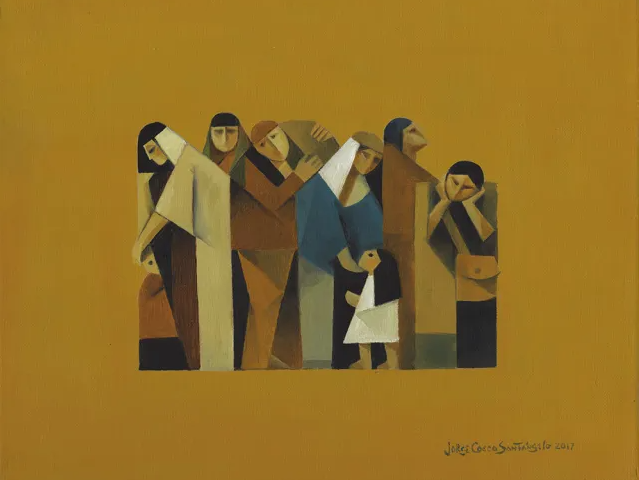
Artwork part of the series, ‘I was a stranger’ by Jorge Cocco Santangelo