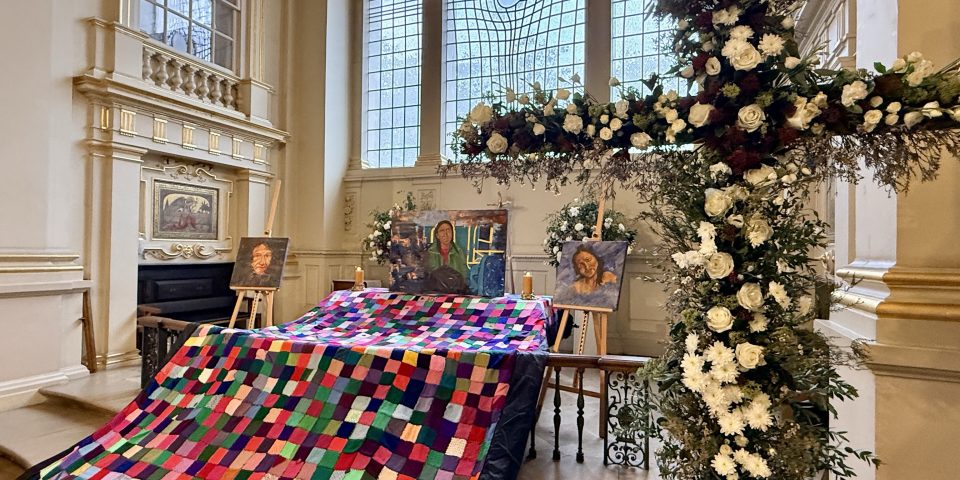
We gather today with sorrow, with love, and with a conviction that every life is precious in the sight of God. Those we remember today cannot be simply summed up by the word “homeless”. Before anything else, they were people: each with a name, a story, hopes and fears; each bearing the image of God.
Some here carry a particular face, a voice, a friendship in their hearts. Some bring grief that is still raw, or questions that have no easy answer. There is room here for all of that. We do not have to tidy our grief before bringing it to God. And alongside our sorrow, there is a scandal we must not soften: that anyone in our society should be without a safe place to call home; that anyone should face death feeling abandoned or forgotten is an affront to the Gospel we preach.
An act of love
Our gathering is an act of love. The circumstances that make it necessary challenge our conscience. Recognising and remembering belong at the heart of our Christian calling. In the Gospel passage before us (Matthew 25:34–40), Jesus identifies himself with those who are hungry and thirsty, strangers, those without clothing, the sick and the imprisoned. He calls them members of his family. What we do for them, he tells us, we do for him. Jesus asks us to look again. Not to see a problem before we see a person. Not to let a label obscure a face. Not to imagine that someone must first become like us before they can belong. Jesus reminds us that those whom the world pushes to its edges are not at the edges of his love. That same love speaks from the cross (Luke 23:39–43). The man beside Jesus asks to be remembered. Jesus answers with the promise, “you will be with me”. A plea not to be forgotten is met with a promise of belonging. In the place of suffering and rejection, Jesus offers his presence, his proximity.
That is the hope in which we gather and remember today. We entrust those who have died to the mercy of God. Where our knowledge of their lives is incomplete, God’s love is not. Where there are memories too painful for words, we may hold them in silence. No life we remember here is beyond the reach of the mercy revealed on the cross. To remember is to resist the idea that a life can simply disappear from our concern.
We honour these beloved children of God not because they had easy lives, but because their dignity was never in question. They belonged to the human family. They were, and remain, beloved of God. But remembrance also turns us towards the living. We cannot undo the deaths we mourn. We can ask whose loneliness we have not noticed, whose voice we have stopped hearing, whose need we have come to regard as inevitable.
A calling we share
The Gospel calls us not only to kindness in a moment of crisis, but to strive for a society in which people have safety, a home, a place and a community to belong. This is not a burden any one person can carry alone. It is a calling we share: to listen without judgement, to stand alongside those who are struggling, to sustain those who offer care, and to challenge whatever denies our neighbours their dignity.
Our remembrance must become attention; our attention into compassion; and our compassion into action. Today, we need not choose between mourning and hope. We can grieve what should never have happened and still trust the love of Christ. We can commend the dead to God and renew our commitment to the living.
It is my prayer that may those whom we remember rest in peace. May all who mourn find comfort and companionship. And may we hear Christ’s call anew: to recognise him in our neighbour, the abandoned and forgotten, to make room in our lives, and to let no one slip beyond our care.
Jesus replied to him, ‘Truly I tell you, today you will be with me in Paradise’.
Amen.
