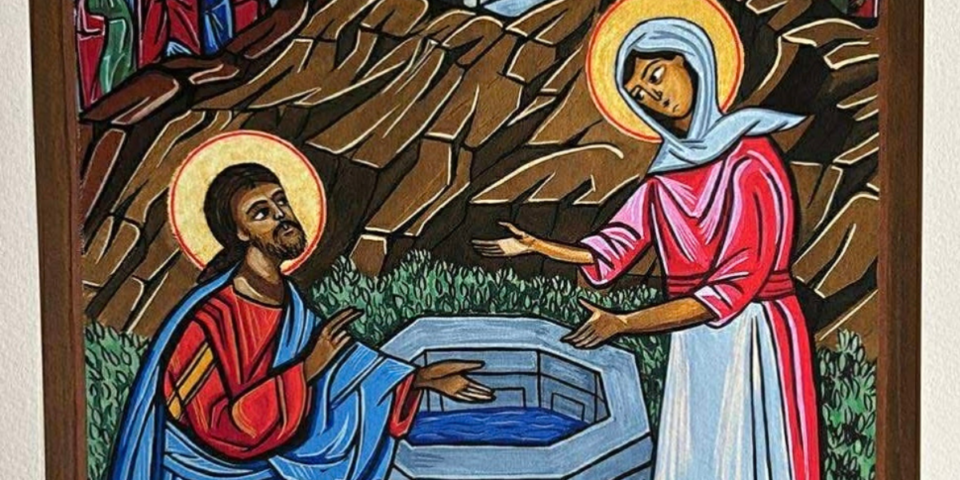
A sermon for International Women’s Day 2026 by the Rt Revd Anderson Jeremiah, Bishop of Edmonton, on John 4:1–42. Reflecting on Jesus and the Samaritan woman, it calls the Church to transgress boundaries, confront misogyny, and practice radical inclusion, justice, and grace.
If there is a narrative that captures the heart of John’s Gospel, it is the encounter between Jesus and the Samaritan woman at Jacob’s well. A story of transgression and transformation.
On this International Women’s Day, when misogyny and sexism is making a glorious comeback thanks to toxic masculinity, we listen to this story not as a simple Sunday School moral lesson, but as a radical manifesto of inclusion.
It is a story where religious, ethnic, and gendered boundaries are not just crossed, they are dismantled paving the way for a new liberated community. To understand the weight of this meeting, we must understand the pollution of the landscape. The geography of contempt. The relationship between Jews and Samaritans in the first century was defined by deep-seated vitriol.
The Samaritans claimed to be the true descendants of the Israelites, yet for the Jewish establishment, they were the ‘other’-ritually impure and tainted, and physically polluting. The divide was so severe that ancient commentary noted: “He that eats the bread of the Samaritans is like to one that eats the flesh of a swine.” What we see here wasn’t just a theological disagreement; it was a systemic exclusion of tainted bodies and polluting culture.
Jesus walks into it. No guiding principles or pastoral accommodation. Jesus simply transgressed the boundaries. The historical and social reality is distilled into the very body of the woman Jesus meets by the well. The unnamed woman carried the weight of being ‘the excluded polluting body.’ For Jesus even to be seen with her could taint him, let alone talk.
When the Holy Man Asks the Polluted Woman for Water
Jesus asks for water, but the woman reminds him that he is trespassing, ‘you are a Jew and you are asking for a drink from me, are you crazy?’ He does not wait for the “impure” to clean herself; he enters her space. By asking for a drink, Jesus violates every religious, ethnic, and gender barrier of his time. Jesus redraws the lines of the social world. In this moment: the ‘holy’ man accepts water from the ‘polluted’ woman. The Sacred and Profane merge, walls crumble, hospitality replaces hostility.
Truth be told, Jesus wasn’t particularly nice to her in the beginning. However, Jesus engages theologically with this unnamed woman from Samaria about God, worship and salvation.
As the conversation progresses Jesus even offers a radical new idea that worship of God will not be limited to a particular community, or a place. In this dialogue, Jesus fundamentally shatters the idea of ‘chosen’ people.
The Samaritan Woman Finds Her Voice
This encounter wasn’t a one-way lecture. While Jesus leads her in confession, the tainted and polluting one unnamed woman steals the show. The Samaritan woman challenges the status quo. I like her sarcasm, where is the bucket? But more importantly she pushes the conversation toward the nature of worship, when her morality was questioned. She found her voice. She leads the conversation and ultimately includes Jesus into her excluded community. Wil Gafney frames the
Samaritan woman as a sharp, engaging theological interlocutor who holds her own in a conversation with Jesus. She challenges traditional, often male-dominated, interpretations that label the woman solely as a “sinner” or “promiscuous”. (Gafney, 2021). Consequently, her hospitality enables him to see beyond ritual hierarchy and tradition.
Jesus speaks of the God of spirit and truth, who cannot be limited to a place or people.
Jesus practices inclusion. Yes. But more poignantly the Samaritan woman, the excluded tainted one, demonstrates expansive inclusion. Crucially it is to this tainted polluted woman Jesus first reveals himself as the ‘messiah’. What a privilege.
The Samaritan woman does not remain a passive recipient of grace. She becomes the first testimony—the first apostle to her people. She brings her entire community to join hands with Jesus, breaking the barriers erected in the name of cultural purity. By accepting her as an equal, Jesus brings down the walls of separation. In the process, both are transformed. The invitation for us today is that we are invited to place ourselves into this story that we may invite the wider church and the world into God’s story of expensive grace and mercy.
Crossing Over to the Samaritans of Our Time
My life is surrounded by women, my wife, my sisters, my daughters and my friends. The reality of theologically sanctified misogyny and sexual violence abounds in our midst. We continue to accommodate exclusion in the name of doctrinal orthodoxy. Women have been offering the costly inclusion, but how long the society and the church will continue to exploit and subordinate them?
Commenting on the intersection of gender and sexual violence within the church, Kelly Brown Douglas say that it is because they are all a part of white, patriarchal, imperialistic, capitalistic power. Heterosexism, homophobia, and misogyny feed this narrative and serve the white male agenda of oppressive power. (Douglas, 2021)
Every person is sacred because every person manifests the glory of God
On the contrary Douglas says what we see in Jesus is that “Jesus let go of his privileges of Jewish maleness in order to show forth the full measure of God’s love. The church must follow in this regard. It must cross over to the Samaritans of our own times.” The Samaritan woman demonstrates that it is through her theological agency which provides resilience to resist such oppressive systems and the resolve to confront stubborn and inherently violent systems of exclusion.
John the Gospel writer makes it clear: because the Word became flesh in Jesus, the human person in their ‘unadorned humanity’ is now the location of the sacred. There are no longer ‘sacred’ or ‘profane’ people. Every person is sacred because every person manifests the glory of God.
I come from a people, the Dalits in India, who know what it means to be an untouchable and polluting community. We also know what welcoming Jesus into our midst could do in transforming our lives. Spirit and truth are not abstract concepts; they are witnessed in our bodies, our thoughts, and our actions.
In this prophetic encounter between the unnamed Samaritan woman and Jesus a new vision of God is birthed, and a relationship reimagined, and then taken tangibly into communities that were historically excluded.
May we, like Jesus leave our privileges behind, transgress the boundaries to transform lives. May we like the Samaritan woman, find our voice to confront theological certainties, invite the world to a table where no one is excluded.
Today when we partake in the reality of Christ, we partake in a love that seeks equality and justice everywhere. Amen.
Image: Revd. C Schnyder
