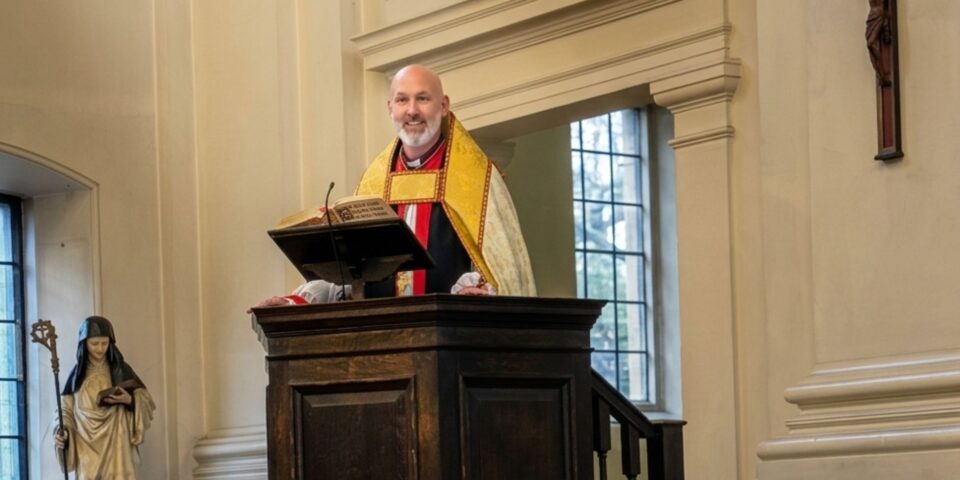
In his Welcome Service sermon at All Saints Poplar, the Bishop of Stepney reflects on theology, the life of the Spirit and the call to proclaim the Gospel in East London. Preaching on Acts 16 and John 15, he sets out a vision of humble orthodoxy, generous faith and missionary witness rooted in Jesus Christ.
Acts 16:11-15
John 15:26-16:4
A Welcome and a Pledge
What a deep joy it is for me to be here with you as your Bishop. Thank you for your welcome. I have returned home and I am so grateful to be amongst all of you.
As you have been so hospitable to me, I want to be hospitable to you. I take seriously my call as your pastor. God has spoken to me often in recent months about the bishop as the shepherd of their flock. So, I want to start with a pledge to all of you. I want to be as accessible and available to you as I can be. I want you all to have my mobile number. Please call me when you need to. I will set aside the whole of Thursday morning each week just to be with you. Please do make the most of that time. That is my commitment to you. Please hold me to it.
Traditionally, Bishops wear symbols of their office. Sometimes they are inscribed with Scriptures close to the bishop’s heart. My episcopal ring reminds me not to get drunk but instead to be filled with the Spirit. It is a call on ongoing holiness. Please pray for me as I seek to sustain a spiritual life in the face of the many demands on my time and attention. Engraved on my pastoral staff is the phrase ‘watch your life and doctrine’ from Paul’s first letter to Timothy. (1 Tim 4:16) These are the qualities Paul wants to see in his overseers, his bishops. The ability to teach is the one skill he demands of us. After that, it is our quality of life, our character and holiness. Nothing more and nothing less.
This, of course, is as true for the priests and people of God as for their bishops. It is what we see in our readings today.
In our Gospel reading, Jesus speaks of the Spirit of truth who will lead us into all truth. It’s this truth that will set us free. It is a truth that we are asked to remember.
In our New Testament reading, Luke tells us about Lydia, whose heart was opened by the Holy Spirit through the preaching of the Gospel. In response, she offers service and hospitality. Truth and service. Doctrine and life.
For me these should always be two priorities for us as a family of churches in East London. It is these things I want to speak about this evening.
Doctrine and Truth
First, doctrine. I want to encourage us, in our common life together to think theologically not ideologically or politically. “God is the only interesting thing about religion” Evelyn Underhill once wrote to Cosmo Lang, the Archbishop of Canterbury and former Bishop of Stepney. It is something this Bishop of Stepney entirely agrees with. So, we must be resolutely and robustly theological in all our speech, because it is God talk. This is our peculiar speech. Our governing grammar. We are speaking of sacred mysteries. To do that well, we must think and speak theologically. As John Webster, former Lady Margaret Professor of Divinity at Oxford encourages us, we must do our theology theologically.
There is, after all, something objective about the Christian faith. Something rational. The Gospel is the good ‘news’ of God’s self-revelation in the person of Jesus Christ. It is a message. We are not making it up as we go along. We pass on what we have once received. The faith once delivered to the saints. This is the Great Tradition of the Church. Doctrine matters. Orthodoxy matters.
At my consecration, I made a promise to uphold the teaching of the church. I intend to keep that promise.
I say that because I believe that good theology changes lives. I am ashamed to say I have a Masters in Applied Theology. By implication there is such a thing as unapplied theology, systematics or dogmatics perhaps. But surely that is just bad theology. Good theology is always applied theology however philosophical it may be. It makes a difference. It convinces the mind, captures the imagination, fuels the passions, and is lived out in practice.
This is the way the spiritual life works. It begins with our thought life. With the renewal of the mind, as the Apostle Paul puts it. It is a renewal because, more often than not, our thoughts are mistaken, deluded, fragmented and distracted. We believe lies rather than truth. That is why it is truth that sets us free. The desert fathers spoke often of this movement that starts with the illumination of the mind, that then reorientates and intensifies our desires, directs our wills and galvanises our actions.
So, theology matters. Our theological debates, discussions, learning, must be unapologetically theological. Whether we are thinking about sexuality, gender, safeguarding, race, nationalism, whatever it may be, let us have the confidence to reason together as Christian theologians. To speak of God. This is the contribution we can offer East London as it asks questions of its own identity and purpose.
I confess I find much of my theological sustenance comes from the Reformed tradition with its strong emphasis on human sinfulness. That includes our reason. This is what the Reformed scholastics meant by ‘total depravity’. Not that we are as evil as it is possible to be, but that sin corrupts our whole being, including our rationality, our thinking.
So, our theology should be a humble orthodoxy. I have my convictions, but I hold them lightly. They remain tentative. Provisional. I could be mistaken. I do get things wrong. I am still learning. I am willing to think again. This means I need all of you to help me think theologically. The Spirit leads us into truth together. In church rather than alone in the study.
So, let’s make sure we think theologically rather than politically or ideologically, and let’s do that together, humbly, as the Spirit leads us into all truth.
The Life of the Spirit
But there is more. It is not only about doctrine. Truth does something. It sets us free. It is liberating, transformative, life giving. Watch your doctrine and your life, says Paul to Timothy. So secondly, I want to talk about the life we live because of our doctrine.
What I am looking for in my own life, and in all of you, is a lively faith. Do you love Jesus and is that love visible in your life? Is there a passion for prayer? A heart for worship? A love of the Scriptures? A servant heart? A confidence to share Jesus with those you meet? Do you constantly stir up the Spirit within you, fanning into flame the gift within you. Or has your faith become jaded and stale? Do you find yourself feeling cynical or outraged? There is too much of that in the church today.
This matters too. Yes, there is something objective about the Christian faith. But Christian faith has an irreducible subjective aspect to it too. An experiential side. It is tangible, felt and lived. This is also the work of the Spirit. This is the great gift of the charismatic tradition to the Church, but it has always been there in the Catholic tradition too. Both traditions are all about an encounter with the living God. Both are renewal movements. We all need that renewal.
This is what we see in the reading from the Acts of the Apostles. The Lord opened Lydia’s heart. Like a book. This is a cracking of the binding of the heart. It is the softening of a hard heart. There is illumination here, but there is also a quickening, an intensification, of her desire, her longing. So, Luke tells us, she listens ‘eagerly’ to the Gospel Paul proclaims.
This is the impact the life the Spirit brings. Worship that’s all in, unreserved, maybe even a little undignified! A heart cry of faith. An explosion of joy. Double shot, full fat, adoration.
Whatever life might be throwing at us, whatever questions we might be asking, this is a deep trust in the goodness of God that inevitably results in praise and worship.
This too is the foundation of who we are and what we do. We might sit in different theological traditions, we might do our theology quite differently, we might emphasise different aspects of the Gospel, but if Jesus Christ is central to our lives, if we are formed by Christ in Word and Sacrament, if our hearts are strangely warmed as we declare the praises of the living God, then we will know the fellowship of the Holy Spirit, that participation in God that is our common inheritance.
Then we can embody, not only a humble orthodoxy, but a generous orthodoxy too, and learn to love one another deeply as God pours his love into all our hearts.
These will be therefore twin emphases for me as your Bishop. A humble orthodoxy rooted in a genuinely theological theology that illuminates our minds. And a generous orthodoxy rooted in the life of the Spirit that ignites our hearts with the fiery love of God and binds us to one another in that love.
The Gospel of Jesus Christ
But what is the catalyst that sets these things in motion? The fuel that propels them forward? That gives them energy? It is a common endeavour. A shared task. What is that endeavour? It is the evangelisation of Tower Hamlets, Hackney and Islington.
So, my absolute priority will be in this. The Gospel of Jesus Christ. And let me be explicit. This means the preaching of Christ crucified.
That on the cross, Jesus overcame the powers of Sin, Death and Satan, bringing us liberation and deliverance from those things that frustrate, enslave and terrorise us.
That on the cross, Jesus faced the horror of everything evil, of the sinfulness of sin, and rather than being overcome by it, absorbed it in his infinite and indestructible love.
That on the cross the judge was judged in our place. That, as the godforsaken one, in a moment of utter alienation and abandonment, Jesus bore our sin, our guilt, our shame, our fear, our wounds, in his body.
That on the cross he died with us and for us. In solidarity with us and as a substitute for us, reconciling us to God so that we can know the joy of adoption into the family of God as his children, a deep sense of assurance and security, and a sure and steady hope for the future.
All of this is ours by faith. Our trust in his faithfulness. Christ has done everything that needs to be done to make what is wrong in the world right again.
This is Good News indeed is it not?
But that is not all. Oh no!
The Gospel is also the declaration that Jesus Christ is Lord. Faith is not only trust. It is a pledge of allegiance too.
He is the risen and ascended Lord who has punched through death and come out the other side, who has defeated these principalities and powers, who has forged a new community of forgiveness, healing, justice, peace, reconciliation and hope as he pours upon us the gift of his Holy Spirit.
This is not a nation, as if the Gospel can be commandeered for political purposes. This is the Church. He calls us to be his ambassadors and his church his embassy, his colony of heaven on earth, as we show and share the love of God in Christ. The world needs to see this city on a hill, this lamp on the lampstand, now, maybe more than ever!
A Missionary Calling
So, it is my prayer, that, together, we can turn our attention away from our own concerns, out towards the world around us, a world in a dark place, but a world that is on our doorstep, and together proclaim the Gospel of Jesus Christ and embody his kingdom on earth.
That means my final pledge to you tonight is this. I will be, first and foremost, your missionary bishop. I will make the most of every opportunity to proclaim the Good News of Jesus Christ with all the energy and creativity I can muster. I hope you will be there with me every step of the way. I know you will.
So, let us pledge together tonight to invite again and again the good people of Stepney into the adventure of faith in Christ, so that every Londoner might encounter the love of God in him.
Amen.
+Rod Stepney
All Saints Poplar
11 May 2026
