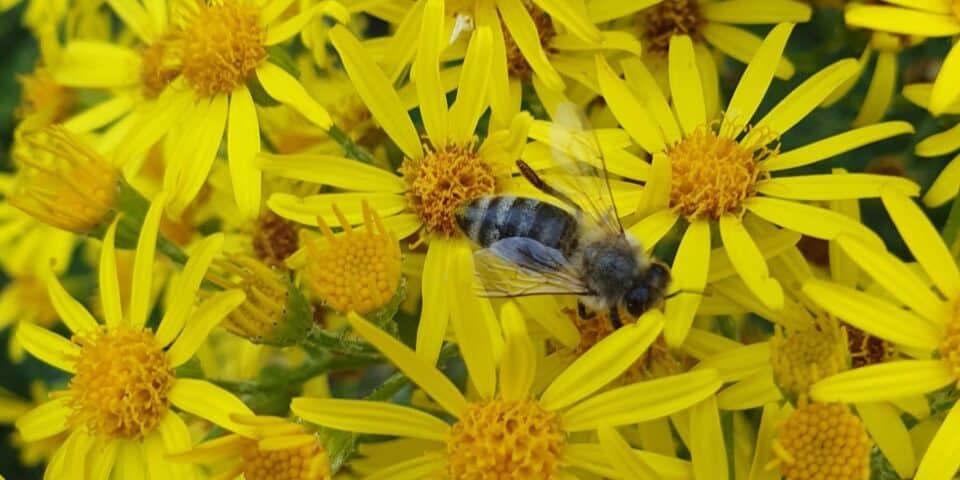
Enid Barron, a member of the diocesan Creation Care Advisory Group, shares the experience of letting her garden grow wild. For information on encouraging biodiversity in your churchyard (or back garden) please visit the Church of England website.
It was not a difficult decision to sign up to ‘no mow May’.
 Our lawn was a disgrace having been host to a gazebo for much of 2021 as a Covid safe place to meet people. Come spring 2022 I happily left the vegetation which remained to grow, curious to see what would emerge. I rejoiced to see grass growing long, mixed with daisies, self-heal, dandelions and groundsel, even when it became hazardous to push my way through it to reach the compost heap at the end of the garden. The rest of the family hated it and on 1st June they insisted on it all being cut. But among the plants whose names I knew a rogue had emerged which grew taller and taller and aroused my curiosity. I pleaded for it to be left until it produced flowers and could be identified.
Then someone who knew about these things saw the leaves, identified it as ragwort, said it was a beast of a plant, deadly poisonous to horses and should be destroyed immediately.
 As I don’t have many ponies (actually none) in my suburban garden I stood my ground and let Mr Ragwort continue to push his way skyward. How thrilled I was when clusters of yellow flowers emerged in profusion from the tall stems.
Every time I saw them like a great splash of sunshine through my kitchen window they brought me almost heart-stopping joy. Then I began to observe the flowers when I was outside, attracted by the buzzing of bees and other insects feeding on the ragwort and seeing some lovely butterflies settling on it. To my surprise the plant also had a beautiful scent.
One renegade ‘weed’ has turned out to be a thing of great beauty and worth, gladdening my heart at a stressful time this summer and contributing to environmental well-being by sustaining a host of pollinators and attracting butterflies. And I began to think how one foot of ground left to itself can produce surprising benefits. How would it be if we replicated this across the country?
Enid Barron is a member of St Stephen’s Ealing, a former member of Diocesan and General Synod, and a current member of our own Creation Care Advisory Group.