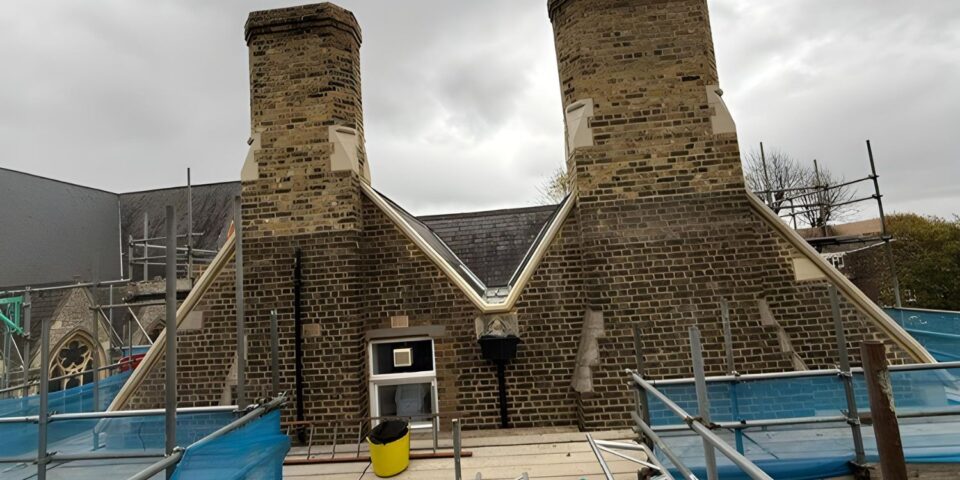
Conservation works at St Mary’s Rectory, a Grade II listed building in Hackney, repaired historic brickwork, Bath stone and chimney stacks using traditional materials. Following listed building consent and close survey, failed cement repairs were removed, indents and mortar repairs completed, and water ingress reduced.
St Mary’s Rectory stands as a significant Grade II listed landmark within the London Borough of Hackney. Commissioned in the mid-19th century, the building was designed by the celebrated Victorian architect Sir George Gilbert Scott, perhaps most famously known for the St Pancras Hotel. The Rectory is constructed from enduring London Stock brick; fired from local clay, these bricks are remarkably resilient compared to softer varieties. Their durability was noted even by Sir Christopher Wren, who remarked:
The earth about London, rightly managed, will yield as good brick as were the Roman bricks … and will endure, in our air, beyond any stone our island affords.
The warm yellow of the brickwork is beautifully contrasted by the buff-coloured Bath stone used for the lintels and quoins, while the roof (consistent with the architectural traditions of the era) is finished in slate with lead gutters.


Survey, Consent, and Repair Strategy
Following the granting of listed building consent last year, a comprehensive scaffold was erected to a design by a structural engineer. This essential access allowed for a detailed assessment of the stonework to determine the most appropriate conservation methods. The team identified where “plastic” mortar repairs were suitable and where “indents”, the careful cutting out and replacement of stone, were required for structural integrity.
While the new stone was being sourced, the chimneys were carefully dismantled. Bricks that remained in good condition were cleaned and set aside, ensuring that original materials were salvaged for re-use during the rebuilding phase.
Preserving the Fabric of our Heritage
Over the decades, various piecemeal repairs had been carried out on the roof and stonework. Unfortunately, many of these earlier interventions had failed due to the use of incompatible materials and a lack of specialist workmanship. A common issue discovered was the over-facing of porous stone with cement mortar. These materials do not work in harmony; while natural stone breathes and weathers, impermeable cement accelerates decay until the repair eventually detaches, presenting a significant safety risk.


Furthermore, the towering chimney stacks on the west elevation had previously been repointed with cement, leading to sulphate attack. This had caused the chimneys to lean toward the building, necessitating a complete rebuild. These structural failings, alongside cracks in the stone, were allowing rainwater to penetrate the upper storeys of the property.
In addition to a significant number of mortar repairs, many specific pieces of stone were replaced, and essential maintenance was carried out on the leadwork and slates. We are thankful that the weather remained reasonably mild during the project’s duration, which enabled the works to progress steadily and reach completion just before the arrival of the first frosts last winter.