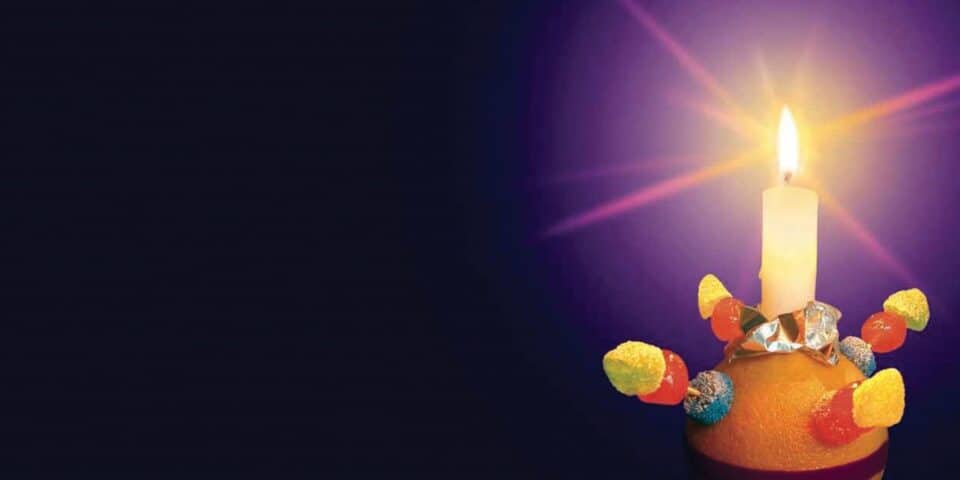
It’s not very often that I choose to dig a candle into an orange, and normally I prefer to eat sweets rather than skewer them with cocktail sticks. But once a year, it’s time to celebrate Christingle, and a collection of household objects becomes the focus for our understanding of Christmas.
Like all good traditions, the origins of Christingle is shrouded in some mystery. It’s believed that the first Christingle service was held in the village of Marienborn, midway between Hanover and Berlin, at Christmas 1747. Children at the first Christingle were encouraged by Pastor John de Watteville to place their lighted candle in their bedroom windows, as a symbol of Jesus’ light shining out.
Christingles were clearly popular, but took over 200 years to reach the UK. In the Church of England, the West Midlands branch of the Children’s Society held one of the first known Christingle services, at Lincoln Cathedral in 1968. Up to 1,500 attended this first service, and the Children’s Society has supported and encouraged Christingles ever since. Today, you can find Christingle services throughout the country, and over a million pounds was raised in 2014.
The first Christingles were simply candles with a red ribbon tied around it. Today’s Christingles include sweets, cocktail sticks and oranges, each presenting a different image of Jesus. There is Jesus the light of the world (candle), the Saviour of the world (red ribbon), the king of the world (orange) and the creator of the world (sticks and sweets). At Christmas, Christingles remind us that the new-born Jesus is also our God, our king and our redeemer.
This year, at St Michael’s, we are making some small changes to the Christingle. The red ribbon of Jesus’ sacrificial blood will be replaced by a purple one, reminding us of Jesus’ majesty and kingship encircling the world. The cocktail sticks (no longer just four) will be a crown, with sweet jewels carefully positioned. This crown, however, is made of sharp sticks, alluding to the crown of thorns Pilate forced upon Jesus. The sharp sticks are a strong image of the pain Jesus surely felt when in a manger, when preaching and, most particularly, on the cross.
Changing tradition can sometimes be discomforting and disorientating. Like many, I get very anxious if Christmas is not done ‘properly’. But small changes can help us to think again about the baby who was born in Bethlehem. Of all that was remarkable at the first Christmas, I think the sight of finely dressed magi worshipping a small baby born into poverty must have been quite breathtaking. Even these wealthy astronomers were not above worshipping God’s Son.
The magi remind us that Jesus subverts our tradition and our hierarchy, even today. So this year, when our neat tradition of Christingles is subverted just a little, is a moment to reflect on the tiny baby who unleashed a revolution on the world. Take your Christingle not just as pretty, but as a reminder of a God whom even kings worship.
Jonathan Brooks is Children’s and Youth Worker at St Michael’s Highgate.