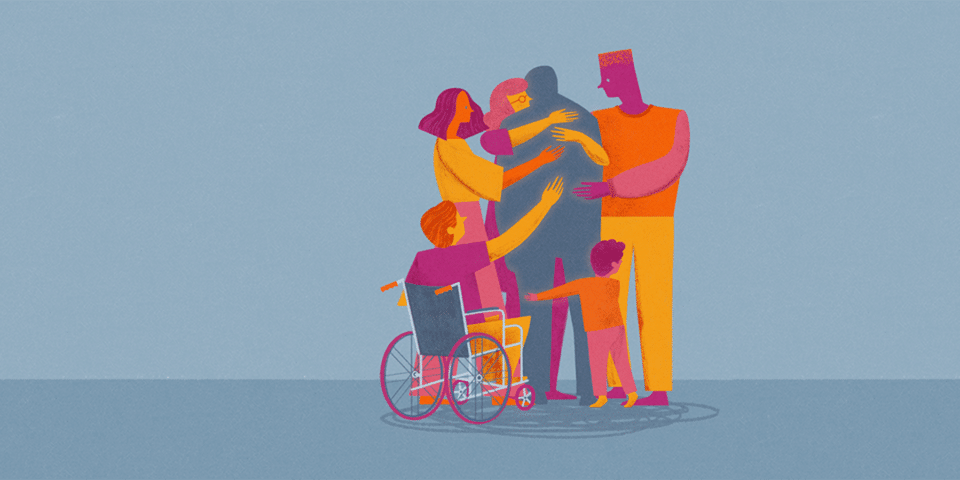
The Revd Joy Beauchamp is a first year curate at St Mary with St Alban’s Church in Teddington. In 2004 her developing career as a management consultant came under intense scrutiny as the result of a major motorcycle accident. A new perspective on both the significance and fragility of life gradually diminished the city’s former allure, and a number of new and unexpected callings began to arise. Since then, Joy has spent over 20 years getting to know her changed body and reflecting on both the encouragement and the challenge of Paul’s words, ‘my strength is made perfect in weakness.’ As her first year of ordained ministry comes to an end, Joy reflects on this journey and how, even with the many physical and psychological challenges it has brought, she has experienced the fullness of life in Christ.
What do you need to feel safe?
During our Advent Course this year, we explored themes emerging from the Covid‑19 crisis. One question we were asked was about safety: “What do you need to feel safe?” It took me a while to gather my thoughts, and longer still to decide whether I wanted to share them. Near the top of my list was the ability to trust my body, or rather, the fact that I so rarely can.
The truth is that, at the moment, I seldom feel safe. Everything about this journey, from discernment to ordained ministry, feels profoundly risky. This, even before considering the challenges of long‑term disability. Yet I haven’t signed up for a life of safety. I have signed up to follow Christ’s call, and Christ’s call often leads us into places that feel decidedly perilous.
When “normal” never returned
In 2004, at the age of 31, contentedly working as a management consultant for PricewaterhouseCoopers then IBM Global Business Services, I was involved in a road traffic accident. After six weeks in hospital, I emerged determined to make a full recovery. But by 2008, after 12 surgical interventions (some small, some major), I still felt dismally far from being able to discard my mobility aids. My life had narrowed to a single focus: trying to return to the way things were before the accident. Everything I longed to do was on hold until “normal” returned.
“Normal” never did return. The city no longer held the same allure. And to make matters more complex, life as it continued included significant periods of low mood and high anxiety, as well as a number of debilitating episodes of inflammation in my central and peripheral nervous system.
Nevertheless, over the years, despite the many things I could no longer do, I slowly discovered a new and much fuller version of myself. Perspective and priorities shifted dramatically. I left the cut‑and‑thrust of the corporate sector for a mix of voluntary and caring roles and responsibilities. Out went mountain biking, hiking and dancing. In came more time for silence and contemplation, for music and reading, and the joy of entering into family life. Alongside this came an unexpected deepening of faith. God had always been at the centre of my life, yet now I found a new mystical awakening, distinguished by a deepening recognition of God in all of God’s Creation, a new awareness of the outpourings of the Holy Spirit, a greater intimacy with Christ, a profound joy at knowing myself beloved of God in the absolute fullness of who I am.
My power is made perfect in weakness
I have long been drawn to Paul’s (oft‑quoted) words: “My grace is sufficient for you, for my power is made perfect in weakness… that is why, for the sake of Christ, I delight in weaknesses… in hardships… in difficulties. For when I am weak, then I am strong….” I have kept these words close over many years, though never without tension; they have reassured and troubled me in equal measure. Much as I might wish to, I (still) cannot claim to “delight” in weakness. Nor do I imagine I ever will.
And yet, I am so conscious that it’s my very brokenness, my myriad places of weakness, that have been integral to my deepening walk of faith; the various challenges, traumas and places of vulnerability that together have opened my ears to God’s call into ordained ministry. And indeed, it was a conversation with a hospital chaplain, during one of my many hospital stays, that precipitated the beginning of the journey. A heart response to the simple question, “where is God in all of this?”
The hardest, most gruelling chapters of my story have now become unexpected wells of insight, compassion and blessing along this new path. Though even as I say this, I am aware of coming to a realisation of this truth only because I have had the immense privilege of tending my wounds within a supportive therapeutic space, where the rawness of experience could slowly be shaped into wisdom, courage and resilience.
For all that has been, thank you
My current challenge is the perennial one, faced by us all, of balancing ‘doing’ and ‘being,’ and recognising when I need to rest. Part of the difficulty is that so much of ordained life is fun, fascinating, necessary and deeply worthwhile, making it painfully hard to say no. Saying “no” to something one doesn’t want to do is a skill I believe can be learned reasonably quickly; saying “no” when every part of the mind and spirit wants to say “yes” is far harder, even when the body is quietly insisting otherwise. In my case, this desire to say yes is exacerbated by a deep‑seated desire to justify the costs of my training, and the amazing opportunities I have been given, by learning to ‘hide’ my disability effectively or find ways to re‑present it as a positive attribute; proving that I can do as much, or more, than my peers who do not identify as having disability. It feels as if the opportunities awarded to others may rise or fall dependent on how well I acquit myself.
And in those moments when my body cannot do the things I want or feel I need, things I once took for granted, or when I watch others doing with (apparent) ease the things I long to do, the sense of frustration and loss is palpable. No, I do not delight in weakness.
And yet. It remains true that my “weakness” has been, and continues to be, used by God, not just my struggles with physical health and mobility, but my anxieties, doubts and periods of low mood. There is even, I think, a certain “fullness of life” that comes from embracing the whole of life: the bad as well as the good, the downs as well as the ups. In this demanding and perilous journey has been the startling discovery of many new gifts, along with moments of exquisite joy.
So, irrespective of health or disability, I proceed, with deep gladness, in our God whose steadfast love accompanies us in all things. I rejoice in the richness and innumerable blessings of curacy life. And I dare to make my prayer and my bold assertion of faith, using the words attributed to Dag Hammarskjöld: “For all that has been, thank you. For all that is to come, yes.”