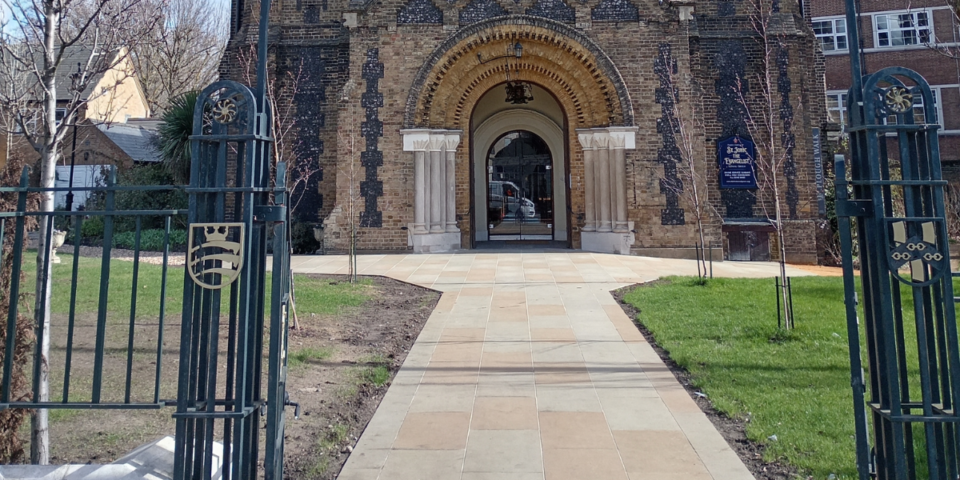
Standing on Harrow Road in north Paddington, near the boundary with Brent, St John’s has served Kensal Green since 1844. Set back from the traffic behind its grounds and trees, it remains one of the area’s most recognisable landmarks and a daily point of reference for residents, commuters and schoolchildren alike.
Accessibility That Enables New Ministry
Now, after 182 years, St John’s Church Kensal Green has become step free. What may appear a modest alteration marks a significant milestone. A barrier that stood for generations has been removed. The message is simple and visible. All are welcome.
“This is not just about paving,” says the Vicar, the Revd David Ackerman. “It is about who can come through the door and how they come through it. A level threshold says you belong here.”
Step free access allows wheelchair users to enter independently through the principal doors. It enables older members to worship without anxiety about steps. It makes it easier for parents with prams to attend services and weekday groups. It also opens new ministry. From March, the church will host a dementia café in partnership with Brent Council.
“A very important thing for Brent Council was that we had step free access,” David explains. “Now we can open the church on Tuesday afternoons for the dementia café. Without that, we simply could not do it.”


Transforming the Grounds for Community Use
The removal of the step forms part of a wider transformation of the grounds. Five years ago, the pedestrian entrance opened onto a tarmac car park. Today it opens onto a York stone path set between lawns. A new side gate, created using restored nineteenth century ironwork, frames the approach. Lighting and CCTV have been installed, strengthening security while enabling the building to remain open.


These changes were made possible through more than £150,000 of investment from Westminster City Council, including £78,000 for paving, lighting, CCTV and the new gate. The partnership developed as new housing increased density in the area and green space became more limited. The council invested in the church grounds, and the church committed to keeping them open for public use.
“In the summer you see huge numbers of people using the grounds,” David says. “People who have no garden of their own. If green space becomes less and less, then invest in our grounds and we will offer them for people to use.”


For David, clarity about the church’s identity has been central to building that trust. “We have to be absolutely clear what we are at heart, which is a church. We are not simply a social community centre. What inspires our connections with the community is what we do on a Sunday. Inclusivity is not a modern box we tick. It is fundamental to what the church is about.”
The building is open every day in a busy part of west London. Rough sleepers come in to sit by the radiator in winter. Others light candles or sit quietly. On Tuesdays the church now hosts a morning playgroup and a community choir. It also distributes welfare support through The Paddington Charities, assisting people of all faiths and none.
“The more you do, the more you are asked to do,” David says. “And the more people connect with what we do on a Sunday.”

The Revd David Ackerman (second right) pictured with the Bishop of Fulham and former Mayor of Westminster and others
Planning Sustainably for the Future
The work is not finished. Westminster City Council has launched a £5 million net zero carbon fund, and St John’s is preparing a bid for the next stage of improvements. Plans include installing solar tiles on the roof and replacing the lower ceiling, which is currently uninsulated. “You have to grasp the opportunity when it comes,” David says. Improving energy efficiency would reduce long term costs, strengthen the church’s environmental responsibility and help secure the building for future generations. Going step free after 182 years is the visible change. The deeper story is one of long-term vision. Targeted public investment has enabled St John’s not only to improve its building, but to strengthen its role as a pillar in the community and to plan responsibly for the years ahead. “We always had the vision,” David says. “It takes five years, ten years, sometimes fifteen. But if people know where you are going, they respond.” After nearly two centuries, St John’s continues to adapt. Its foundations remain the same. Its doors are open to more people than ever before, and its future is being built with equal care.