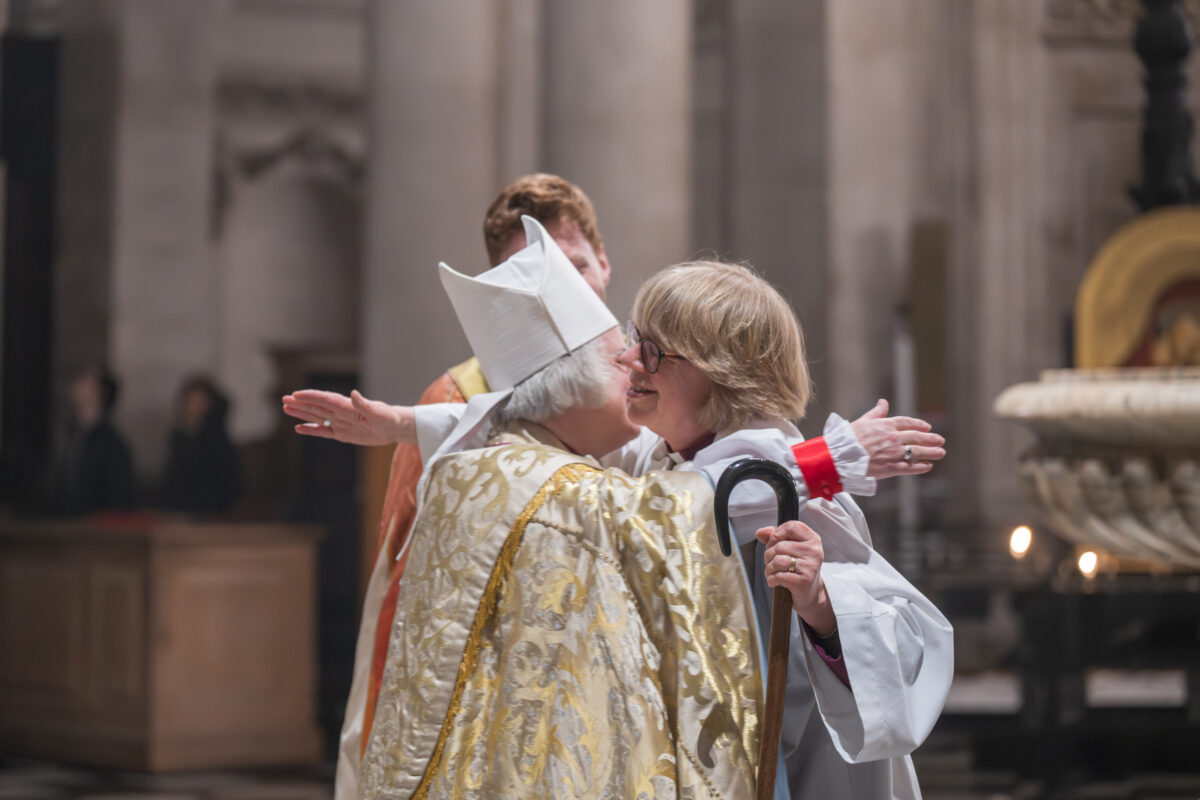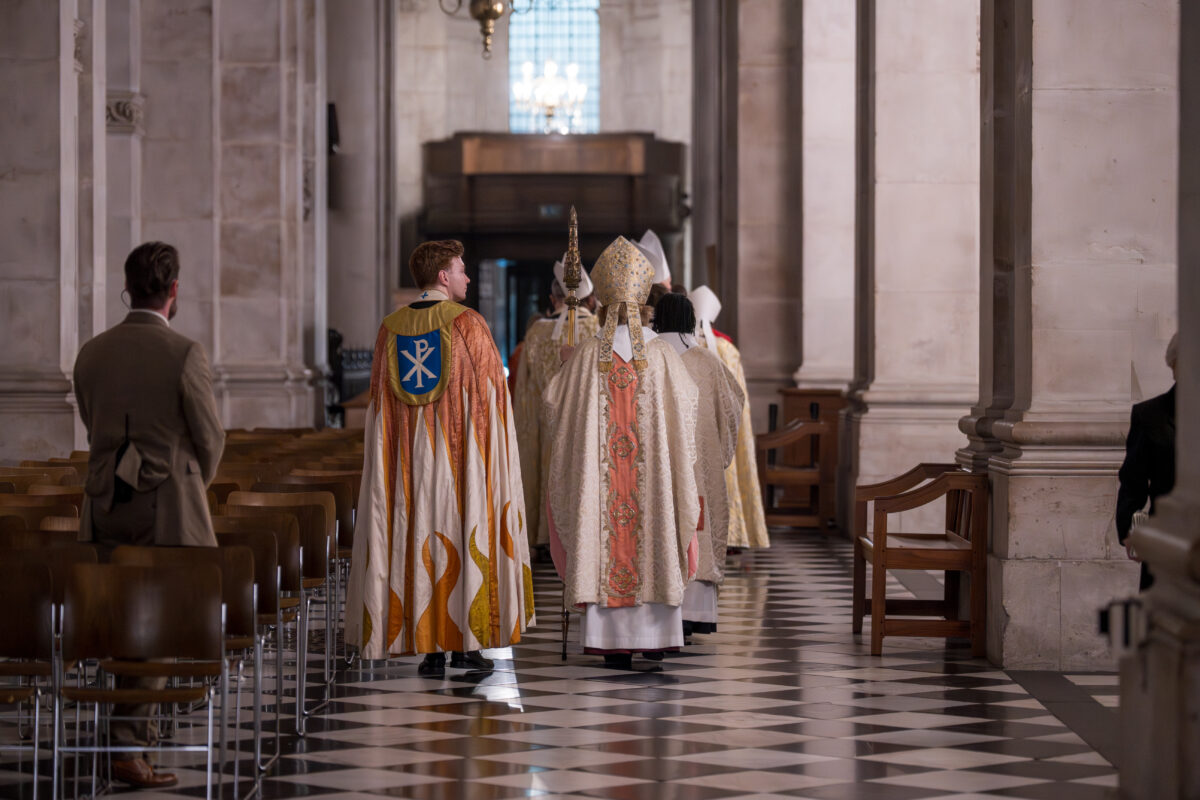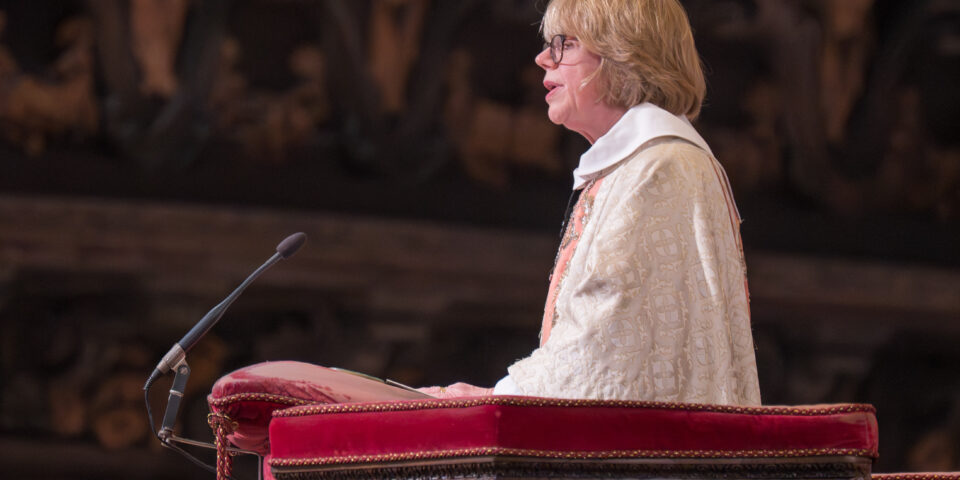
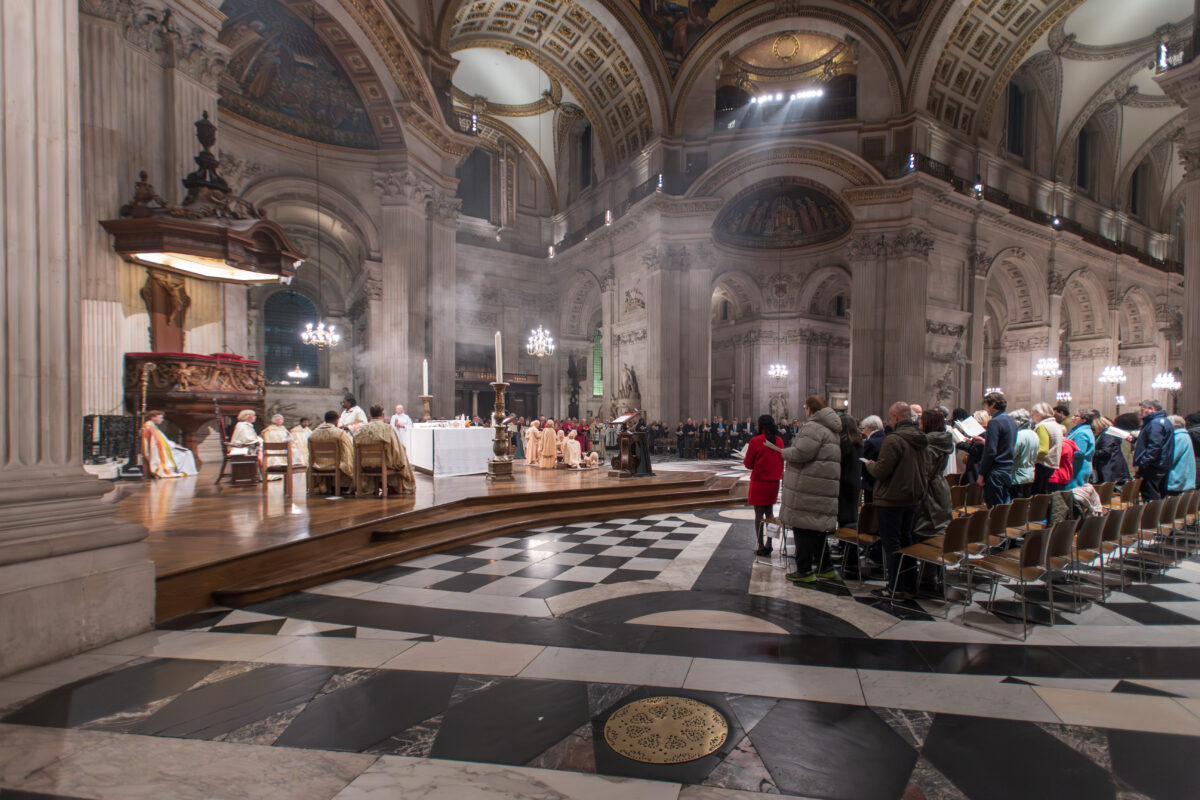
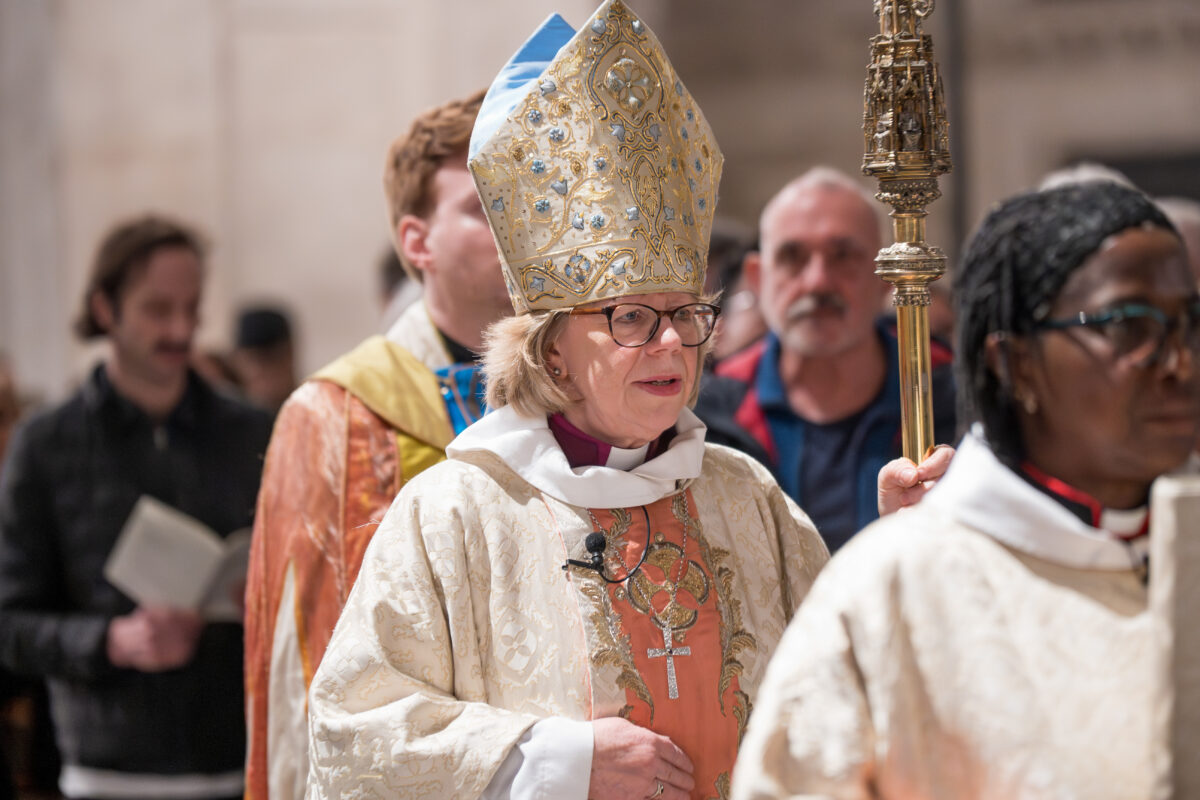
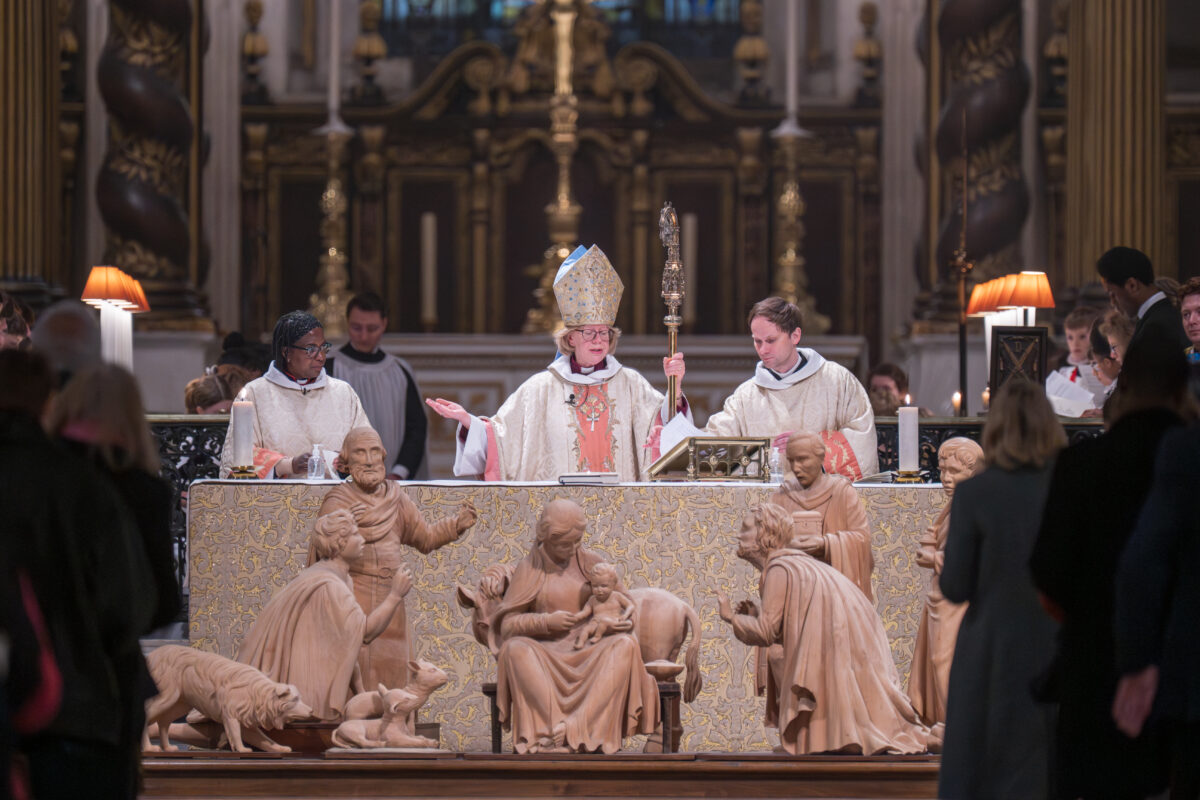
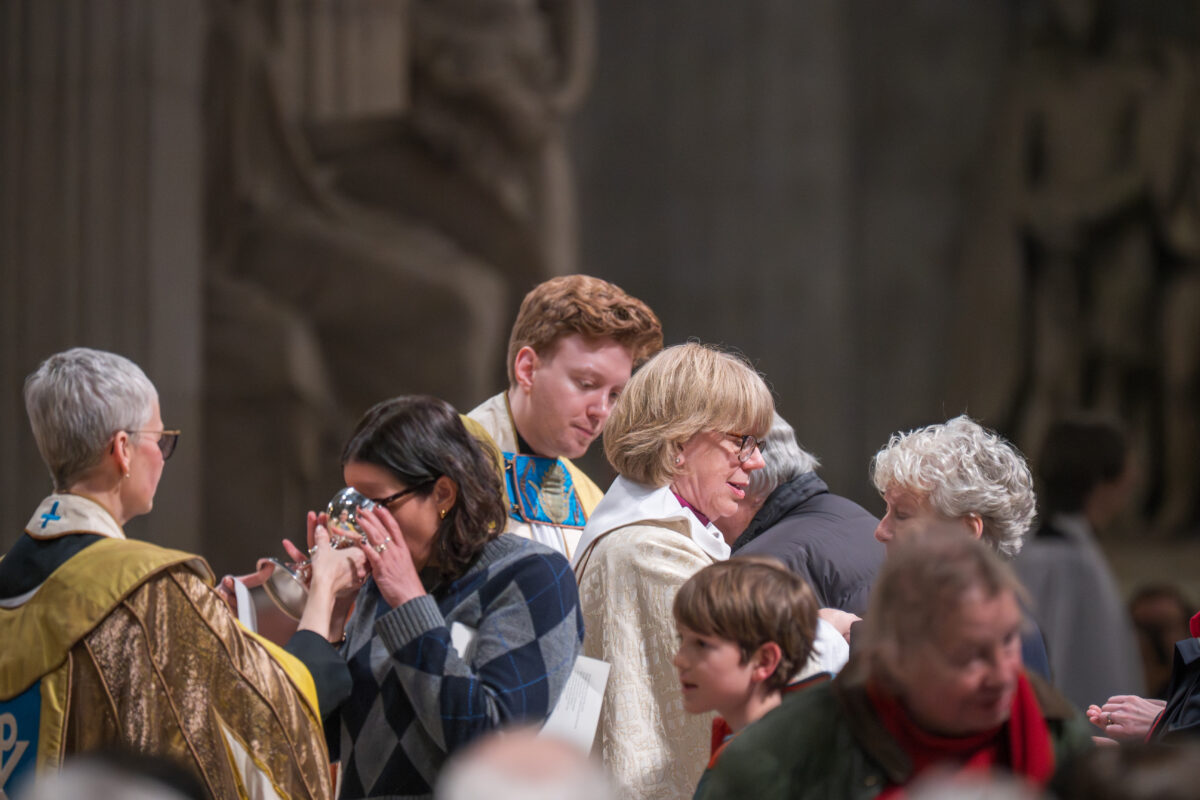
Bishop Sarah Mullally’s sermon preached at St Paul’s Cathedral on Saturday 17 January as the clergy and people of the Diocese gave thanks for her ministry to London.
‘For we do not proclaim ourselves; we proclaim Jesus Christ as Lord and ourselves as your servants for Jesus’ sake.’ (2 Corinthians 4:5)
Beloved: I cannot quite believe that we have reached this moment. It is with great sadness that I say goodbye to a Diocese and a people I love. You have shaped me into the priest and the person I am today. If it were not for you and all that you have taught me, I would not be going to Canterbury. For which I am grateful. I think!
As I said to the clergy at last year’s Chrism Eucharist, you are a blessing to those among whom you minister. I know this because I have visited your churches and your chaplaincies, your parishes and community projects, and witnessed what is happening there.
I believe that I have seen the Kingdom of God – the pearl of great price – emerging in each place. Through the way you nurture disciples, new and old; your gloriously varied liturgies; your thoughtful and inspirational preaching; your prophetic social justice initiatives; your care of the vulnerable and isolated – in all of these and so much more I have seen the signs of the Kingdom among you.
The clergy do not do this alone, of course. This Diocese is blessed with lay people whose gifts and skills are offered with extraordinary generosity in the service of Christ. Whether you belong to a congregation or one of our governance bodies, are a church officer or a member of diocesan staff, an adviser or a volunteer – whatever your role, I hope you know the blessing that you are and the blessings that you bring. Being a lay Christian, committed to the building up of God’s church and God’s Kingdom, takes huge time and energy and is costly. I am not sure that the church always recognises this, but I see you all – and I rejoice in your faithfulness and the grace of your presence here.


Vacancies are inevitably times of uncertainty and can feel de-stabilising. A natural response is to retreat into our comfort zones, whatever that means, as we wait for the in-between times to end, the change to come, and stability to return. But liminal times can clear space for growth and learning, and for seeking wisdom. This vacancy can be such a time for you. This is not just because you are in good episcopal hands – which you undoubtedly are – but because London is a place where churches are not only confident in the Gospel but also confident in their identity – in their unique ministries – confident that they are being what they are called to be in their very particular context.
That is a good thing. And being confident in your own identify is an especially good thing when it gives you the grace to recognise each other’s strengths and learn from each other’s perspectives.
In my eight years among you, I have prayed with you, laughed with you, wept for you in your times of struggle, and sought to support your unique ministries. And where I have seen you do this for one another – especially reaching out to one another across your different traditions – I have rejoiced.
In his book, The Missing Peace, Chris Whittington – founder of the School of Contemplative Life – suggests how the Kingdom comes about in the world.
He says that as we learn to know the love of Christ in the very depths of our being, the Kingdom becomes a present reality in our hearts.
He writes, ‘the foundation for a wholly different future is to be found in the very heart of who we are’, because as we live Christ’s love, we ‘become places where the kingdom happens’.[1]
That knowledge of God, in our very depths, shapes our relationships with one another – not just theoretically, but in ways that can be touched and seen. And that leads us to discover and to uncover the Kingdom. The pearl of great price.
We have heard the parable of the pearl of great price many times and the point seems obvious: that the pearl is extraordinarily precious and the merchant will give anything to own it. But perhaps we can push the imagery further. Pearls do not come out of nowhere. Pearls emerge through attrition over a long period of time. There is no pearl without the grit.
And I want to suggest that to become places where the Kingdom happens, we must be willing to weather and work with the challenges which are the grit of our life together in the Body of Christ.
These are often the challenges of difference, conflict and misunderstanding among ourselves. They are real, and they are painful, and they tempt us to withdraw from one another or even throw stones from a distance. But only by digging deep to find the courage to remain in one another’s presence and in relationship together do we truly, as individuals and communities, ‘become places where the kingdom happens’. Only this way can the pearl of the Kingdom be formed in its hard-won but incomparable beauty.
Our differences do not just make us uncomfortable – they are, at times, deeply painful. It would be easier to walk away or create distance from those who look and think and feel and believe differently from ourselves. But this would be to assume that we have a monopoly on the Kingdom: what it looks like and who belongs in it. But it isn’t our kingdom – it’s God’s kingdom – and we are clay jars, limited in our understanding, fragile in our humanity, and in need of one another – all of us. The more we live this truth, the more we will channel the love of God in the world, and the more Christ will be glorified.
This does not mean that we cannot challenge on another, as iron sharpens iron.
In her soon-to-be-published book, Bishop Emma quotes from Leyton E. Williams, who says about the seeming disunity among believers:
‘Embracing the holiness of disunity doesn’t mean seeing beauty or purpose in every argument; it means seeing that there is beauty and purpose in every person and maybe in the discord itself. Disunity is stretching us, pushing us – both together and apart, refining us, and along with all the other holy work of God, making something new’.[2]
So yes, we should challenge one another, but the purpose of the challenge is to build one another up, not to destroy, and this will make all the difference to how we go about it. I have quoted Cole Arthur Riley a number of times in recent years, and she bears quoting again. She writes:
‘To be able to marvel at the face of our neighbor with the same awe we have for the mountaintop, the sunlight refracting—this manner of vision is what will keep us from destroying each other’.[3]
There will be times when we feel compelled to call out what we perceive to be one another’s mistakes or misunderstandings. But we should not seek to harm or destroy one another in the process. We should not deliberately shame one another.
Our intention should always be to bear with one another’s weaknesses and encourage one another’s fruitfulness as together we work for the Kingdom and seek a deeper wisdom than we can find alone. As Wisdom chapter 7 reminds us, God ‘is the guide even of wisdom and the corrector of the wise’. However wise we may be, we are not always right. We have much to learn from one another. This will always be true.
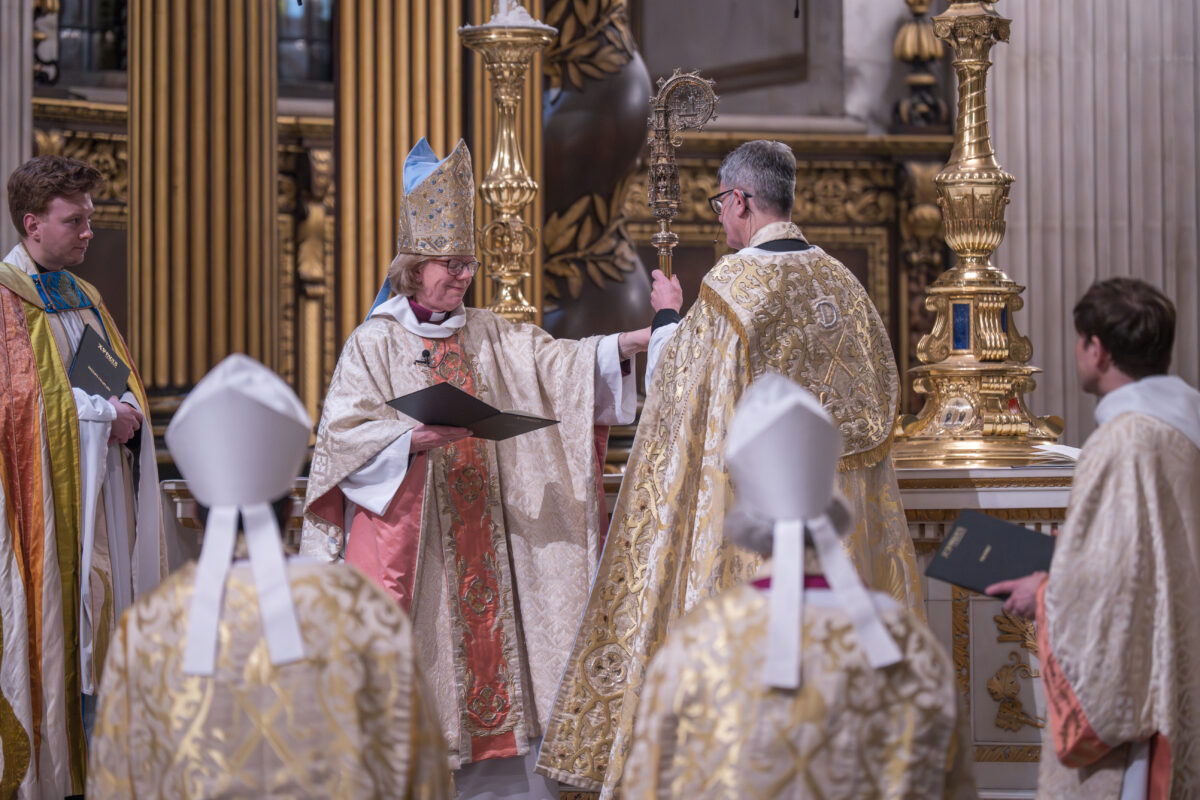


There has been much talk in recent years about the responsibility of bishops to be a focus of unity. Experience tells me that that is rarely possible in the way that people mean it. I venture to suggest that in the whole of the Church of England there is not one bishop around whom everybody will gather in agreement. But perhaps that is a misunderstanding of the task. What bishops can do is encourage each and every disciple, each and every worshipping community, to recognise the gift and blessing of the other.
As a College of Bishops in London in recent years, we have mirrored some of the differences of theological conviction and liturgical approach which are found among you. In doing so we have come to see the beauty and purpose in one another, and in our different perspectives, and then in every person, lay or ordained, among whom we minister in the life of this Diocese.
In this extraordinary melting-pot of a city there are endless opportunities for witnessing to the love of Christ. The more our relationships are shaped by the love Christ has shown each one of us, the more we recognise our need of one another, the more we build one another up, the more Christ is glorified.
For isn’t this wisdom: if, in the midst of our many differences, we are united in our determination to proclaim Jesus as Lord, gazing on the face of Christ and seeking to reflect his glory, recognising that it’s not about us, it’s about the God who we worship. As St Paul so eloquently put it: ‘We do not proclaim ourselves; we proclaim Jesus Christ as Lord and ourselves as your servants for Jesus’ sake’.
We have, in the past eight years, grown together in wisdom. It has not always been easy. I have not always got everything right. You have challenged me, and I think and act differently now because of some of those challenges. I want to thank you for the part you have played in urging me towards deeper wisdom, in times of grief as well as times of joy – especially when this has been done in kindness and in the spirit of mutual learning. I hope that we have learnt much together. In particular I am grateful that you have taught me that our strength lies in our diversity, in our willingness to see Christ uniquely reflected in each person, in having the humility to receive the gift of one another even when we deeply disagree, and that we achieve our greatest reach for the Kingdom when we build one another up in hope and humility and love.
‘For we do not proclaim ourselves; we proclaim Jesus Christ as Lord and ourselves as your servants for Jesus’ sake.’
Please pray for me in the next stage of my calling, as I will always pray for you.
[1] Chris Whittington, The Missing Peace, p91, Canterbury Press 2025
[2] L. E. Williams, Holy Disunity: How what separates us can save us (Westminster John Knox Press, 2019), pp. 190–91.
[3] Cole Arthur Riley, This Here Flesh: Spirituality, Liberation and the Stories that Make us,