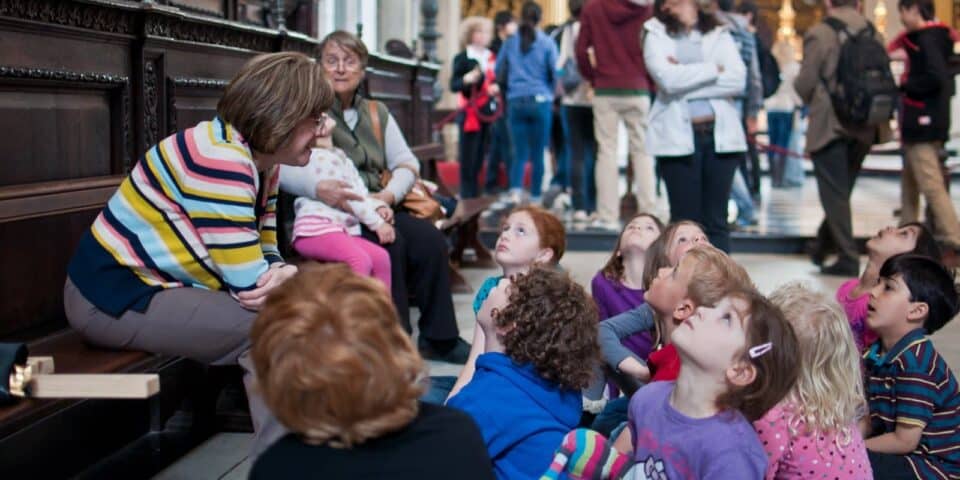
A recent review of children’s and youth ministry projects in London Diocese has helped pinpoint the factors that help give these projects the greatest chance of success, not just in London but in the wider Church. Here we summarise the findings and Sam Donoghue, Head of Children’s and Youth Ministry Support at London Diocese, offers some explanation and reaction.
This guest article is by Catherine Ellerby, freelance writer, in conversation with Sam Donoghue, Head of Children’s and Youth Ministry Support. It was originally published in this form in the Resourcing Mission Bulletin in March 2016.
Introduction
In London Diocese, employing a children’s or youth worker is on the increase, in recognition of the inherent potential in these roles for growing the Church. The Bishop of London’s Mission Fund (BLMF) plays a key role in promoting and funding children’s and youth work across the Diocese. Over 40 projects have been funded in the last 10 years.
The BLMF is focused on maximizing the impact of its grants. An external review was commissioned in 2014-2015 to look at the effectiveness of previous grants. The aims were to understand what typically drives success in a project and assess what can be put in place to ensure future projects are set up with the right foundations and support.
Sam Donoghue offers support and advice to those involved with children’s and youth work in London’s 400 churches. He explains more about the evaluation project:
“Every children’s and youth worker wants their work to be meaningful. We don’t head into this children’s ministry thing expecting or looking for failure – we want our work to be significant for the children and young people, and to thrive. Equally, every church or funder wants the projects or activities they support to work, and to engage the children and young people taking part. But what is it that makes a project, and the role of the children’s worker, ‘work’? And how can we ensure that the groups, activities and projects we are working on are moving in the right direction?”
The review process
The research was based on reviews of projects which had received funding from the BLMF and detailed interviews with church leaders involved with these. The aim was to find out which of the projects and roles had seen the most success.
The research looked into a wide variety of projects, deliberately focusing on not only those which were successful but those which struggled too. Each project was evaluated and ranked according to its success. Sam says:
“The research was externally commissioned which meant the consultant was able to bring a fresh perspective. He read every single review form ever submitted and then went to visit a selection of 21 projects – both those that were successful and those that failed. Speaking to project workers, line managers, vicars and even those who attended the projects gave a good picture of the key factors in making projects a success and indeed what will cause a project to struggle.
“Some of the factors we already knew, it was intuitively obvious from our experience, but also some of it was more surprising and pushes against some more established norms. Many of the points centred on employment but others are more relevant generally when launching any new project in a church.”
Key success factors in children’s and youth ministry projects
The research found that several key factors make longer term success in children’s and youth ministry projects more likely.
Making the right appointment was found to be one of the most important success factors. Sam says:
“Making the right appointment might be the most obvious statement imaginable but this is often the most important thing you do for a children’s or youth work project. If you make a bad appointment there is no amount of mentoring and support that can save the project, but getting the right person means the project is likely to fly. We heard again and again that it is crucial in the recruitment phase to hold your nerve and not appoint unless you’re really sure. If that means going through the recruitment process multiple times and not appointing anyone you interview, then so be it. Parishes that panic and appoint the person who is the best on offer in the interviews rather than the right person for the job always regret it. In London right now it’s become normal to have two goes at appointing.”
The character of the worker was shown to be far more important than their skills, which, says Sam, flies in the face of much established logic:
“We have attempted to professionalise our workforce and we often include a youth or children’s work degree on the personal specification but our research showed us that this doesn’t matter as much as we hope.
“What we’ve seen is that qualifications – for example, degrees in children’s and youth work – are great in terms of depth of thinking etc. but they are not necessarily leading to better output in practice. What we need to be looking for are people with staying power, the ability to enthuse and inspire others and who can shift the culture of a church. You can teach those people about children’s and youth work. Parishes have tried the opposite and thought they could motivate someone with some skills and a degree but it doesn’t work.
“If you can get that person with the entrepreneurial spirit required then you will still have issues to deal with: you may have to reign them in at times and getting them to consent to being trained can be a battle but fundamentally you’ll be having good problems around harnessing their energy as opposed to getting someone going.”
Good line management was also shown to be essential, increasing the likelihood of success. Sam says:
“Good line management is crucial but only in forming and steering an entrepreneur. The research showed that meetings should focus on ensuring objectives are being met and that the worker is reflecting well on their work and not just charging ahead without thinking about what they’re doing.”
Knowing the area was another essential factor helping a project to succeed. Sam says:
“It’s not enough to have a good idea or even a vision – good research into your local area is crucial. Just because someone else has had huge success with a project, that doesn’t mean it’s going to work in your locality. It’s vital to take time to engage with the local community and find what’s already out there but oversubscribed and where there are needs that aren’t being met.”
Engaging and enthusing the whole church (PCC and congregation) in the vision for children’s and youth work was shown to lead to successful ministry projects:
“Making children’s and youth work an integrated part of church life is crucial for building momentum, driving internal funding and growing the volunteer base,” says Sam. “Too many of us are content to live in a silo aside from the church and accept the fact that no one gets what we do. This attitude however will slowly kill your project. Many parent and toddler groups get founded by churches with great missionary objectives but some then slowly get detached from the church until the only input from the church community is to complain about the way the hall is left afterwards: this is probably not something Jesus is very chuffed about.”
Prioritising relationships, and taking a “whole life” approach above an overemphasis on programmes and activities also leads to greater chance of success. Sam comments that:
“It’s easy to obsess with getting our programmes slicker and more exciting but where projects prioritised deep relationships over better programmes we saw success. Actually setting up programs is the easy bit; we are learning not to be impressed with them when we review but to dig deeper to see what relationships the programmes are facilitating. Caring about people and building trust builds a powerful witness.”
Building a strong volunteer base is important, rather than leaving the children’s/youth worker to do everything. Sam says:
“Volunteers are crucial. Projects that are too dependent on a key worker can only survive as long as the key worker is around and are therefore incredibly fragile. Recruiting and empowering volunteers is a constant mission that pays off over time with a broader leadership than just one person, leading to greater creativity in planning and space for the key worker to think and reflect.”
Powering through plateau. The findings point to the need to avoid plateauing in children’s and youth work ministry projects. Sam says it is possible to keep going even if it’s hard work and may mean asking for help from others:
“Although much of what’s been said above will mitigate against this, there is a clear trend of projects hitting a plateau in year two, often caused by the fact that the early years are spent settings things up and launching programs and there is then a transition in focus to developing and growing the groups and people find this difficult. Getting through this stage requires a big effort from more than just the worker but it can be done. Often a response to it is to try and launch a new program but that won’t solve the problem.
“Expert advice is really important. We saw a direct link between success and engagement with the training and resourcing we provide as a diocese for all youth and children’s workers. Those that sat on their own tended to struggle more. This need for expert advice also spreads into fundraising and any number of other things specific to the projects, but it’s amazing how many projects struggle on without taking the help that is on offer.”
Planning for long-term sustainability is also a key factor in a successful project:
“Longterm sustainability is not an accident; you have to plan this from the start. There can be an assumption that sustainability happens because successful projects generate momentum that keeps then going and going. We assume that it’s easier for other churches as they have a huge pool of willing volunteers that you can only dream of. This simply isn’t true, the projects that make it work for the long haul do so because they have been thinking that way from the start and working with that in mind.”
So what are the sort of steps that long term successes have been taking to achieve longterm sustainability? Sam explains that many have established a clear long-term vision and have built with that in mind from the start, systematically putting in place the foundations needed. This includes things like integrating children’s and youth work into the wider vision of the church, fundraising and succession planning. He also suggests that for some projects the prize was in getting the project up and running and they failed to think beyond that. By the time they do it is too late and they rarely last longer than a couple of years.
“Long-term projects are realistic in their expectations,” says Sam. “One of the temptations when planning a project is to be too ambitious: we’ve learnt that our funding model can encourage this and we need to be more willing to fund less ambitious projects. We have seen that doing less really well by putting more resources into fewer projects is far more effective. Therefore, a project plan should have logical and realistic objectives. If you want to start two things put all your efforts into getting one right before you try and move on the other one.”
Conclusion
One thing which stands out for Sam – especially where projects were less successful – is a need to highlight the support available and encourage those in children’s and youth ministry to tap into this, through the dioceses in particular:
“We saw projects which were huge successes, some which were somewhere in the middle and others which had really struggled for a number of reasons or fizzled out after a strong start. It really struck me that in a number of projects where the children’s/youth ministry was not thriving or a project hadn’t succeeded, there was a worker who wasn’t plugged into any networks and therefore struggling alone. In some cases, they had fallen to pieces and left. My message to anyone in this situation and to the wider church is that people like me and many others across the church in specialist and advisory positions are here to help – that’s why we’re in post so there’s no need to struggle/give up!
“The other important thing is that this research was carried out not based solely on anecdotal evidence. Of course we want to hear stories about what’s happening out there, to highlight good practice and point to models which can be used in similar situations; but this review used a more methodical approach and had a focused remit, taking the 43 projects and systematically looking at what had worked and hadn’t.
“That’s a clear strength for me, and what we now have is some clear messages which can help the BLMF but may also benefit churches in other dioceses and indeed the wider church as it continues its mission to grow with a focus on children and young people.”
By Catherine Ellerby, freelance writer, in conversation with Sam Donoghue, Head of Children’s and Youth Ministry Support, London Diocese. This article draws on material previously used in an article by Sam Donoghue published in Premier Childrenswork magazine in Autumn 2015.