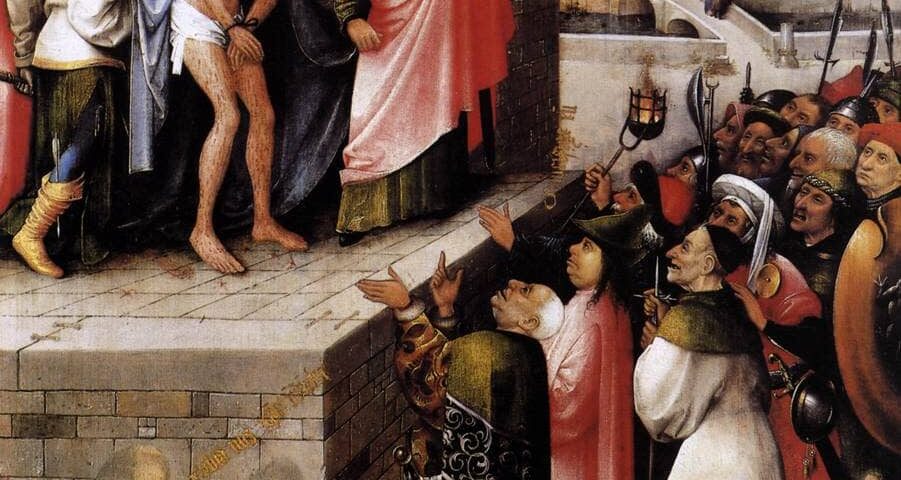
This year, as Easter in some London boroughs falls outside the school holidays, we might expect more children and young people to be in church over the weekend. They are less likely to go away, maybe!
The passion story is long and detailed and there is never enough time to do it justice. The Easter story may be told at school but that is not necessarily in the context of building faith. In the Church of England, Passiontide begins on the fifth Sunday in Lent specifically to allow more time to engage with Christ’s passion. But a lot of children’s ministry begins with Jesus’ entry into Jerusalem on Palm Sunday, the events of Holy Week are briefly covered on Good Friday (if the church offers any specific children’s worship) and then we arrive at Easter Day. It’s all so quick.
I have always liked the idea of telling the Christmas story in the middle of summer and the Easter story at other times in the Church year. But I am interested that the very early Easter of 2016 has prompted me to assess the overall quality and depth of our engagement with the Easter story with children. So this year we are beginning our journey along the passion narrative in the middle of Lent and will return to the resurrection record long after the summer term has begun.
So that’s why, in the third week of Lent, at the after-school club, we were reading Matthew’s account of Jesus’ trial before Pilate. It includes plenty of detail that’s not found in the other Gospels: the anxious intervention of Pilate’s wife or the fact that it was a choice of two Jesuses – Jesus Barabbas and Jesus, the one called the Messiah.
Just occasionally a question pops up which proves to be the one to unlock children’s minds and tongues. This day one such question emerged. It was very simple: who comes out worst in this story? There are lots of contenders and we went around the group enthusiastically stating our preference.
The crowd began as favourites, loudly and violently choosing Barabbas over Jesus. But Pilate had the power to save Jesus. Yet how much power did he really have? He had enough to have Jesus viciously flogged!
The chief priests and leaders convinced the crowd and Pilate knew exactly what game they were playing. (They are my choice!) We discussed how Hitler and other historical figures have manipulated the crowd.
Pilate’s wife could have been more insistent since she must have known her husband’s weaknesses. One boy was batting for Barabbas, who could have refused to be substituted by an innocent man! Then one girl argued that in her opinion they were all to blame. This led on to discussing how far we too are responsible for Jesus’ death. A sobering thought but an inspiring debate.
I look forward to continuing our journey towards the cross together, and of course, we’ll have to squeeze in an Easter egg hunt before Holy Week begins! It’s all a bit confusing. Let’s pray that children and young people in the London Diocese experience the Easter story in a deeper way, assisted this year by the dates of the academic term.
Anna Giles is a children’s and families’ worker in North London.
Image: ‘Ecce homo’ by Hieronymus Bosch (circa 1450–1516) [Public domain], via Wikimedia Commons.