
The challenge of food insecurity
It is no secret that food insecurity is a challenge with deep roots. Today, food aid is not an emergency response for a minority of people in crisis; it has become an unofficial part of the welfare state. It serves those in work as well as the unemployed; families alongside individuals; and those with and without disabilities, whose benefits do not provide enough to make ends meet.
Across London, churches are working hard to respond to food insecurity and the challenges that frequently accompany it, such as debt, isolation, and poor mental health. They utilise different models to address hunger – each with a valuable place on the Food Ladder. In the Summer of 2025, I was welcomed at three very different church food projects in Westminster, with distinctive strengths and styles. Running through them was a shared heart for pastoral care and community building.
Independent food bank at St Matthew’s, Bayswater
Description
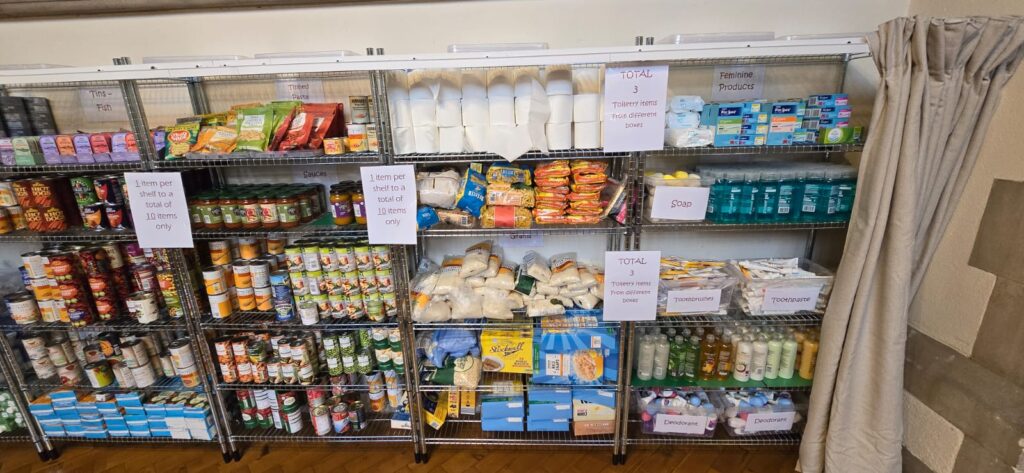
The St Matthew’s food bank opens its doors once a week to people living in the locality. Guests are invited to take up to 10 food and / or hygiene items of their choosing, free of charge and without any kind of referral. Refreshments are available during the session and guests are welcome to sit and chat – making use of the communal space, in an area lacking in community venues. A CAP Debt Advisor visits once a fortnight and a hairdresser – a former food bank guest – frequently joins the sessions to offer free and low-cost cuts and colour to guests.
Reflection
One advantage to the independent food bank model is that food bank teams are empowered to distribute food in the best way they see fit. St Matthew’s is able to operate without referrals and has determined the geographical area that it can realistically and sustainably support. The fact that guests are able to select 10 items of their choosing means that this small, independent food bank avoids the criticism that is sometimes levied against larger food bank projects – that an overly prescriptive approach to food distribution can lead to a lack of agency for users and contribute to food waste.
Research has shown that the most effective foodbanks provide additional support for related insecurities. It was great to see that, by partnering with two other churches, St Matthew’s Bayswater is managing to meet the cost of trained CAP worker to provide free community debt advice during the food bank session.
Your Local Pantry at Emmanual Harrow Road

Description
The Your Local Pantry model, developed by Church Action on Poverty, operates as a social supermarket / community shop. People living locally can sign up to become members of the pantry, enabling them to do one grocery shop per week where they pay £5 to receive a basket of goods worth £20–£25. A clever stickering system allows shoppers to purchase a range of items, priced as hearts or diamonds. While hearts represent lower-value everyday essentials, such as tinned goods and basic veg, diamonds denote more costly / premium items such as fresh meat. Each shopper is entitled to a certain number of products from each sticker group – balancing customer agency, with fairness between shoppers, and project sustainability.
Reflection
The membership model of Emmanuel’s “Your Local Pantry” means that it can serve a wide variety of people in the community: those experiencing marked food insecurity, those whose shopping budgets are just a bit tight, and those (in whatever income bracket) who happen to live locally. In this way, it reduces any real or perceived stigma around making use of the service.
I was interested to see that the Emmanuel Harrow team have implemented a helpful opt-in communications channel for members: ahead of pantry opening hours, they share a video overview of the pantry’s newest stock, so shoppers can know if there is something available that they may want to stop by for. This helps shoppers to plan their visits and gives the pantry team some insight on when the pantry could be busy.
Food Cycle at St Pauls, Marylebone

Description
Unlike the other two projects, the primary purpose of the Food Cycle programme is not to combat food insecurity. Its main aim is to combat social isolation, while addressing both food insecurity and food waste as secondary objectives. Its modus operandi is a weekly, community meal open to residents of the nearby housing estate and local community. On the day of the meal, volunteers receive rescued and surplus ingredients from City Harvest and draw up a three-course menu accordingly. Anyone from the community is welcome to join the meal, with no obligation to pay. All food is nut-free and vegetarian or vegan, which works well for the locals, who belong to a variety of faith traditions (and have differing dietary requirements). Guests are invited to take home any leftovers in the recyclable containers provided.
Reflection
Food Cycle at St Paul’s has been running successfully as an interfaith effort since its inception. The team at St Paul’s serve faithfully alongside members of the West London Synagogue, as well as those from all faiths and none who volunteer through Food Cycle. The meal hosts are therefore as diverse as the local community and regular meal attendees. I was struck when St Paul’s staff told me how, at times during the last year, when religious and ethnic tensions have been heightened within London, those tensions have not been felt in the same way in the local area. Here, interfaith and intercultural relationships are the norm, and community events, like the Food Cycle meal, are nurturing friendships across difference.
Food models: similarities and differences
| Model | Eligibility | Food & Funding Sources | Challenges | Leadership & Staffing | Community Building | Christian Distinctiveness |
| Independent Food Bank (St Matthew’s Bayswater) | Those in the locality | Harvest festival donations, grants, “too good to waste” products donated by supermarkets & bakeries, church funding, Fare Share. | Maintaining supplies – and the significant coordination and admin around this. | Internal church team supported by regular volunteers. | Café runs concurrently. Foodbank serves as a hub for other services. | Clergy & church worker participation, provision of pastoral support |
| Your Local Pantry (Emmanuel, Harrow Road) | Those in the locality who become members | Wholesaler purchases, City Harvest donations, “too good to waste” products donated by supermarkets, grants. | Maintaining supplies – esp. with the fluctuating prices of certain staples. Uncertainty around future grants. | Church team leading a franchise, according to the YLP model, supported by regular volunteers. | Membership system – shoppers are known. Members are invited to a separate community drop-in session. | Clergy & church worker participation, provision of pastoral support |
| Food Cycle (St Paul’s, Marylebone) | All welcome | Rescued and surplus vegetarian food, provided by City Harvest and organised and distributed by Food Cycle. Additional donations from harvest collections and local businesses (grants and food gifts). | Needing to think quickly and creatively as food is delivered on the day. Location of the kitchen has had to change a couple of times – a need to work flexibly. | Food Cycle employee on the church team, supported by a varying cast of Food Cycle volunteers | A weekly community meal. Weekly cooking sessions including new and experienced volunteers. | Clergy & church worker participation, provision of pastoral support |
My sincere thanks go to Liz and John at St Matthew’s, Jackie and Keith at Emmanuel, and Clare and Bill at St Paul’s – all of whom graciously took the time to explain to me about their local contexts, and the strengths and challenges of their incredible food projects!
If you are thinking of starting or expanding a food project, or of transitioning from one model to another, please feel free to reach out to the Compassionate Communities team for a conversation.